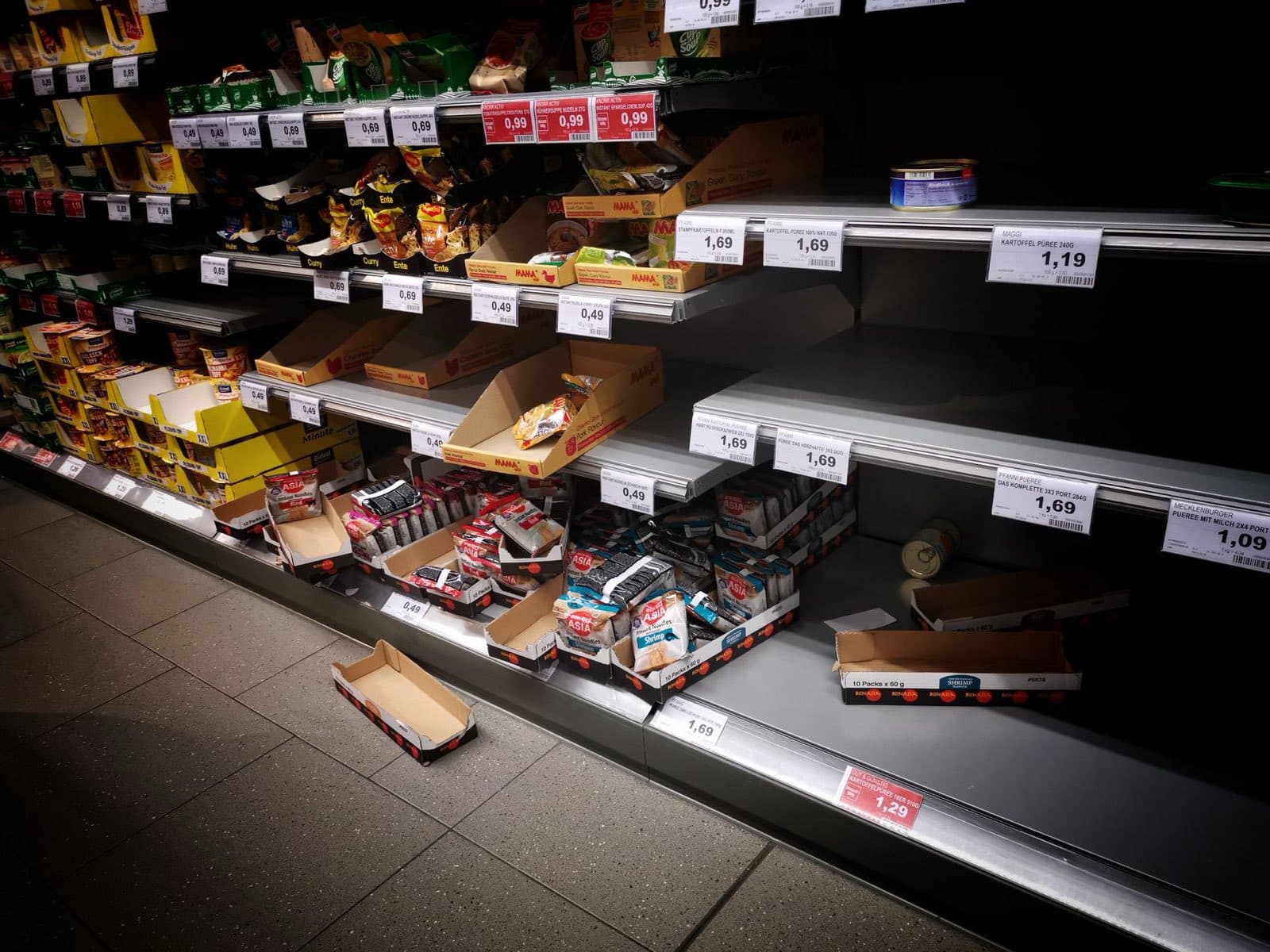
Quick answer
American food shortages are almost always narrow and temporary: one storm, one plant closure, or one panic emptying specific aisles for weeks. The household answer is boring and complete: 30 days of the food you already eat, bought gradually, rotated always, plus the confidence to substitute when the exact brand is gone. Depth converts national headlines into shrugs.
Supply numbers are set for 4 people. Change your household size below and every quantity updates.
30 days
Pantry depth target
Narrow
Most shortages hit specific items, not food
FIFO
First in, first out: rotation in one word
$15/wk
The gradual build rate that gets there
How a shortage actually unfolds
The trigger
A freeze in one state, a recall, a plant fire, a shipping snarl. Somewhere upstream, one node in a very long chain stumbles.
The headline week
News crews film the emptiest shelf in town. Panic buying arrives, which empties three more aisles and makes the story true retroactively.
The gap weeks
Specific items stay scarce or pricey for two to eight weeks while the chain reroutes. Households with depth are eating last month's groceries at last month's prices.
The quiet recovery
Shelves refill without a headline. The deep pantry restocks at normal prices, ready for the next pothole.
Your household's number
What do those 30 days take for your house?
The figures above are sized for a typical household. Set yours and you'll get the calories, gallons of water, and what they cost for your people. About a minute, no signup.
Food and water calculator
How much food and water does your household need?
Adults
Children
For how long
You'd need
210,000calories
plus 120 gallons of water, around $395 to buy.
For 2 adults, 2 children, 1 month.
That's the target. Provision Planner counts what you already have and shows you what's left to buy.
See how close you arePlay it out
One empty-shelf month, three decisions
A processing plant fire two states away, played honestly from the cereal aisle.
Scene 1 of 3
Tuesday. A fire took a major processing plant offline, and the news says weeks of disruption for canned goods and pasta. Your store looks normal today, but the story is everywhere by dinner.
Prefer to read it straight through?
Scene 1
Tuesday. A fire took a major processing plant offline, and the news says weeks of disruption for canned goods and pasta. Your store looks normal today, but the story is everywhere by dinner.
If you race everyone to the store tonight: You and four hundred neighbors with the same push alert. The shelves that were fine at noon are stripped by nine, partly by you. It works, sort of, at the cost of a grim hour and a cart of whatever was left.
If you check the pantry ledger first, then shop only actual gaps: The pantry says 26 days deep with pasta heavy and canned fruit light. Tomorrow you buy fruit and skip the scrum. Knowing your own depth converts every shortage headline into a specific, small errand.
Field note: Panic buying is what happens when households discover their inventory in public, during the event. The ones who know their depth shop like accountants while everyone else shops like contestants.
Scene 2
Week 2. Your usual store is patchy: no favorite pasta, one canned-chicken brand at double price, eggs limited to one carton. The kids' lunch routine leans on exactly two of those.
If you pay whatever it takes to keep the routine identical: Double-price chicken, gray-market eggs from a parking-lot guy, routine preserved at premium cost. The budget takes the bruise, and next week's prices are worse because everyone else paid too.
If you substitute from depth: different shapes, different proteins: Rotini replaces the favorite, beans and tuna cover chicken duty, oatmeal picks up two breakfasts. Groceries stay on budget and the kids survive the shape betrayal. Flexibility is the skill shortages actually test.
Field note: Shortages are usually brand-and-format specific: the calories exist two shelves over. Households that substitute ride through at normal prices; households loyal to exact SKUs pay the scarcity premium.
Scene 3
Week 6. Shelves are quietly refilling and prices are easing. The pantry that carried you is 12 meals lighter than its target. It is also nobody's news story anymore.
If you crisis over. back to nine-day-pantry life: The depth that just paid for itself dissipates in a month of not-bothering. Next pothole, and there is always a next one, the household is back in the headline-week scrum with everyone else.
If you restock the drawdown at recovered prices, keep the system: One extra item per trip, four weeks, and the buffer stands at 30 days again, bought at post-shortage prices. The pantry is not a purchase; it is a rhythm, and the rhythm is the preparation.
Field note: The rebuild window after a shortage, when prices recover but memory is fresh, is the cheapest and most motivated moment to restore depth. Depth spent is only lost if you skip the refill.
The food shortage checklist
People in your household
One page per scenario: quantities resize in place, and the link you share always shows this plan.
Your head start
0 of 30 days covered
0 of 8 essentials on hand
Tick what you already own.Save this as your real plan →Supplies buy you days. Gear keeps those days livable. Most families discover they start around day 3.
| Item | For 4 people | Why it matters | Covers | |
|---|---|---|---|---|
| Water · 28 gallons total | ||||
| Bottled water, 24-pack cases | 6 cases (about 17 gal) | Sealed, portable, splits between rooms and the car. | Days 1 to 5 | |
| 5-gallon water jugs | 3 jugs | The cheapest gallons you can store. Fill spares before the event, not during. | Days 6 to 7 | |
| Water purification tablets | 1 pack | Turns suspect tap or tub water into drinking water after day 7. | Backup | |
| Pantry depth, rotated | ||||
| Canned protein: tuna, chicken, beans | 77 cans | Eats straight from the can when the stove is out. | No cooking | |
| Canned vegetables and fruit | 86 cans | Fluids and vitamins while the fridge is dark. | No cooking | |
| Peanut butter | 9 large jars | 2,650 calories per jar, no prep, kids will actually eat it. | No cooking | |
| Crackers, tortillas, granola bars | 17 boxes plus a dozen bars | The bread aisle empties first. These keep for months instead of days. | No cooking | |
| Oats and shelf-stable milk | 26 cartons plus a canister of oats | Breakfast without power, and the milk needs no fridge until opened. | No cooking | |
| The rotation system | ||||
| Shelf markers or a marker pen | 1 | Purchase month on every lid makes first-in-first-out automatic. | System | |
| One shelf's worth of ingredient staples | Flour, oil, salt, yeast | Ingredients substitute for missing products: bread happens when bread aisles do not. | Flex | |
| Manual can opener | 2 | The month of cans has exactly one single point of failure. Own two of it. | Critical | |
| Health and documents | ||||
| First aid kit | 1 | Minor injuries spike during cleanup, exactly when help is hardest to reach. | All week | |
| Prescription medications | 14-day supply each | Pharmacies reopen slowly. Ask your pharmacist about an emergency refill before you need it. | 2 weeks | |
| Documents in a waterproof bag | IDs, insurance, cash in small bills | ATMs and card readers die with the power. | Grab and go | |
| Manual can opener | 1 | Most of the calories above are locked inside cans without it. | Critical | |
This list is a normal month of eating, stored in the right order. Nothing here is exotic, and everything rotates into regular meals. Print this page to take it shopping.
In the app
Know your depth before the headline does
Provision Planner is literally built for this scenario: your pantry, counted in days for your real household, with expiry-aware rotation flags. When the next shortage headline lands, you check the app, not the aisle.
Run the shortage scenarioFood Shortage scenario
Pantry depth
26 days
Rotation flags
4 items this month
Water
8 days
Shared with household
Yes
Computed from your real inventory. Updates itself as things expire.
Frequently asked questions
Are real food shortages actually possible in the US?
Narrow ones happen constantly: eggs, formula, specific canned goods, regional produce. Broad, lasting scarcity is very unlikely in the American system, which is exactly why a 30-day buffer works: it outlasts the realistic gap almost every time.
How do I build a month of depth without a big spend?
One or two extra staples per normal trip, roughly $15 a week, reaches 30-day depth in about three months. Buy only what you already eat, mark purchase months, and eat oldest first. The budget never feels it.
What foods should anchor the pantry?
The same anchors as the supply plans on this site: rice, oats, pasta, canned proteins, canned vegetables and fruit, peanut butter, shelf-stable milk, and cooking oil. Boring, cheap, long-dated, and all things your household already eats.
Will my stored food go to waste if nothing happens?
Not if it rotates: depth is just your normal groceries, time-shifted. You eat the pantry continuously and replace it continuously; a shortage simply pauses the replacement side for a few weeks while you keep eating normally.
Explore more scenarios
Every scenario gets the same treatment: the event, the supplies, the timeline, and your number.
 Scenario 12Pandemic
 Scenario 14Economic CollapseScenario 20Job Loss
 Scenario 07Grid Failure
 Scenario 06Power Outage34 scenarios, one libraryBrowse them all →
Go deeper: 1-Month Supply Plan for 4 People · Food Storage Calculator
Supply chain framing follows USDA market reporting; storage targets follow FEMA guidance extended to household depth. This is general planning guidance: build depth from foods your household actually eats. Photography: NASA image library and Pexels, used under their respective licenses.