
Quick answer
Nobody can schedule a depression, and the internet's version, gold bars and bunkers, prepares you for a movie. The household version is measurable: a 30-day pantry so groceries flex when money will not, a cash cushion in small bills, debts and subscriptions trimmed while times are normal, one skill that earns outside your paycheck, and neighbors you actually know. Every one of those pays off even if the economy never breaks.
Supply numbers are set for 4 people. Change your household size below and every quantity updates.
30 days
Pantry buffer target
Regret-proof
Every step pays off in good times too
Burn rate
The number that decides your runway
Neighbors
History's most reliable safety net
How hard times actually arrive
The slow slide
Downturns arrive in quarters, not mornings: prices creep, hours get cut, one industry stumbles into the next. The window to prepare is famously long and famously ignored.
The squeeze
Household math tightens: same income, thinner margins. The pantry buffer starts doing quiet work, absorbing grocery volatility a week at a time.
The hard stretch
Job losses touch your street. Runway math, barter-adjacent favors, and the skill that earns on the side move from theory to Tuesday.
The rebuild
Every downturn so far has ended. Households that avoided high-interest debt during the stretch rebuild years faster than those that financed the gap.
Your household's number
What do those 30 days take for your house?
The figures above are sized for a typical household. Set yours and you'll get the calories, gallons of water, and what they cost for your people. About a minute, no signup.
Food and water calculator
How much food and water does your household need?
Adults
Children
For how long
You'd need
210,000calories
plus 120 gallons of water, around $395 to buy.
For 2 adults, 2 children, 1 month.
That's the target. Provision Planner counts what you already have and shows you what's left to buy.
See how close you arePlay it out
Three lean years, three decisions
A long recession, played at kitchen-table scale. No zombies, just math.
Scene 1 of 3
Year one, early. Groceries cost 20% more than last year, gas stings, and the news argues about soft landings. Your household budget still balances, barely, without anyone having decided anything.
Prefer to read it straight through?
Scene 1
Year one, early. Groceries cost 20% more than last year, gas stings, and the news argues about soft landings. Your household budget still balances, barely, without anyone having decided anything.
If you ride it out. budgets are depressing: The margin quietly goes to zero over six months, and the credit card starts catching overflow at 24% interest. Nothing dramatic happened; the household just never chose, and the card chose for it.
If you run the burn-rate audit while it is still optional: One evening with the statements: four zombie subscriptions gone, insurance re-shopped, the car decision deferred a year, $340 a month recovered. Painless now, and exactly the margin that becomes oxygen if the squeeze deepens.
Field note: Burn rate is the one economic variable a household fully controls. Cutting it during calm feels like discipline; cutting it during crisis feels like loss. Same cuts, wildly different price.
Scene 2
Year one, late. A neighbor two doors down, laid off in the spring, mentions his family is having a beans-and-rice month while severance stretches. Your pantry is 30 days deep and your job feels stable, for now.
If you sympathize politely, stay out of it: Understandable, boundaries are real. But hard stretches are long games, and the network you did not build in year one is the one you will wish existed if year three knocks on your own door.
If you bring two grocery bags and zero ceremony: Pasta, cans, peanut butter, and a joke about pantry overflow so it lands as neighborliness, not charity. Eight months later he is the one who hears about a contract role before it posts, and your name is the first he says. Nobody keeps score, and everybody is keeping score.
Field note: In every documented downturn, informal neighbor networks outperformed savings accounts as safety nets. Two grocery bags in year one is the cheapest resilience purchase on this entire page.
Scene 3
Year two. The layoff wave reaches your company: your team survives, your income does not grow, and prices keep climbing. The pantry buffer has been absorbing grocery spikes all year. A voice online insists real preparation means converting savings to gold.
If you buy the gold. it feels decisive: You now own a shiny asset that pays no interest, costs a spread both directions, and cannot feed anyone Tuesday dinner. The actual household risks, thin cash and a single income stream, are exactly where they were, minus the decisiveness glow.
If you boring resilience: cash cushion, pantry rhythm, weekend skill: Three months of expenses reaches the savings account, the pantry keeps rotating at 30 days, and the weekend repair skill starts earning actual side money. None of it photographs well, and all of it is load-bearing when the third year gets tight.
Field note: Households do not experience economic collapse as a currency event; they experience it as a cash flow event. Liquid cushion, low burn, deep pantry, and a second income skill answer the version that actually arrives.
The economic resilience checklist
People in your household
One page per scenario: quantities resize in place, and the link you share always shows this plan.
Your head start
0 of 30 days covered
0 of 9 essentials on hand
Tick what you already own.Save this as your real plan →Supplies buy you days. Gear keeps those days livable. Most families discover they start around day 3.
| Item | For 4 people | Why it matters | Covers | |
|---|---|---|---|---|
| Water · 28 gallons total | ||||
| Bottled water, 24-pack cases | 6 cases (about 17 gal) | Sealed, portable, splits between rooms and the car. | Days 1 to 5 | |
| 5-gallon water jugs | 3 jugs | The cheapest gallons you can store. Fill spares before the event, not during. | Days 6 to 7 | |
| Water purification tablets | 1 pack | Turns suspect tap or tub water into drinking water after day 7. | Backup | |
| Pantry depth, rotated | ||||
| Canned protein: tuna, chicken, beans | 77 cans | Eats straight from the can when the stove is out. | No cooking | |
| Canned vegetables and fruit | 86 cans | Fluids and vitamins while the fridge is dark. | No cooking | |
| Peanut butter | 9 large jars | 2,650 calories per jar, no prep, kids will actually eat it. | No cooking | |
| Crackers, tortillas, granola bars | 17 boxes plus a dozen bars | The bread aisle empties first. These keep for months instead of days. | No cooking | |
| Oats and shelf-stable milk | 26 cartons plus a canister of oats | Breakfast without power, and the milk needs no fridge until opened. | No cooking | |
| The financial layer | ||||
| Cash cushion in small bills | Start with one week of expenses | Bank outages, card freezes, and tight weeks all bend to physical cash. | Liquidity | |
| The burn-rate audit | One evening, twice a year | Subscriptions, insurance, and autopay drift. Recovered margin is runway. | Habit | |
| One earning skill outside the paycheck | Pick and practice | Repair, sewing, tutoring, baking: hard times pay ordinary skills surprisingly well. | Runway | |
| A garden bed or containers | Start with one | Not self-sufficiency, just the highest-morale groceries that exist. | Depth | |
| Health and documents | ||||
| First aid kit | 1 | Minor injuries spike during cleanup, exactly when help is hardest to reach. | All week | |
| Prescription medications | 14-day supply each | Pharmacies reopen slowly. Ask your pharmacist about an emergency refill before you need it. | 2 weeks | |
| Documents in a waterproof bag | IDs, insurance, cash in small bills | ATMs and card readers die with the power. | Grab and go | |
| Manual can opener | 1 | Most of the calories above are locked inside cans without it. | Critical | |
Half this list is groceries, the other half is habits. Every line is worth doing even if the economy has a lovely decade. Print this page anyway.
In the app
The pantry is the part of the economy you control
Provision Planner tracks the buffer that carries households through tight years: pantry depth in days, rotation so nothing wastes, and totals that make the grocery buffer a number instead of a feeling.
Run the resilience scenarioEconomic Collapse scenario
Pantry depth
31 days
Rotation flags
2 items
Water
7 days
Buffer value
Tracked
Computed from your real inventory. Updates itself as things expire.
Frequently asked questions
Should I be buying gold or crypto for this?
This page stays in its lane: it is about household logistics, not investment advice. What history does show is that families experience downturns as cash flow problems, and that pantries, low burn rates, skills, and neighbors addressed that directly in every documented case.
What does a deep pantry have to do with the economy?
Groceries are the most flexible major expense a household has, and a 30-day rotated buffer is what makes them flexible: it absorbs price spikes, lets you buy only sales, and converts to weeks of runway if income stops. It is self-insurance you eventually eat either way.
How much cash should be at home versus the bank?
Enough small bills at home to run essentials for a week or two through a bank outage or card freeze; cushion beyond that belongs where it earns interest. The home cash is for friction events, not for replacing the banking system.
Is this scenario not just doom-mongering?
The opposite, hopefully: every action on this page is regret-proof, meaning it improves ordinary life even if no crisis ever comes. Deeper pantry, lower burn, one more skill, better neighbors. That list has no downside case, which is why it beats the bunker fantasy.
Explore more scenarios
Every scenario gets the same treatment: the event, the supplies, the timeline, and your number.
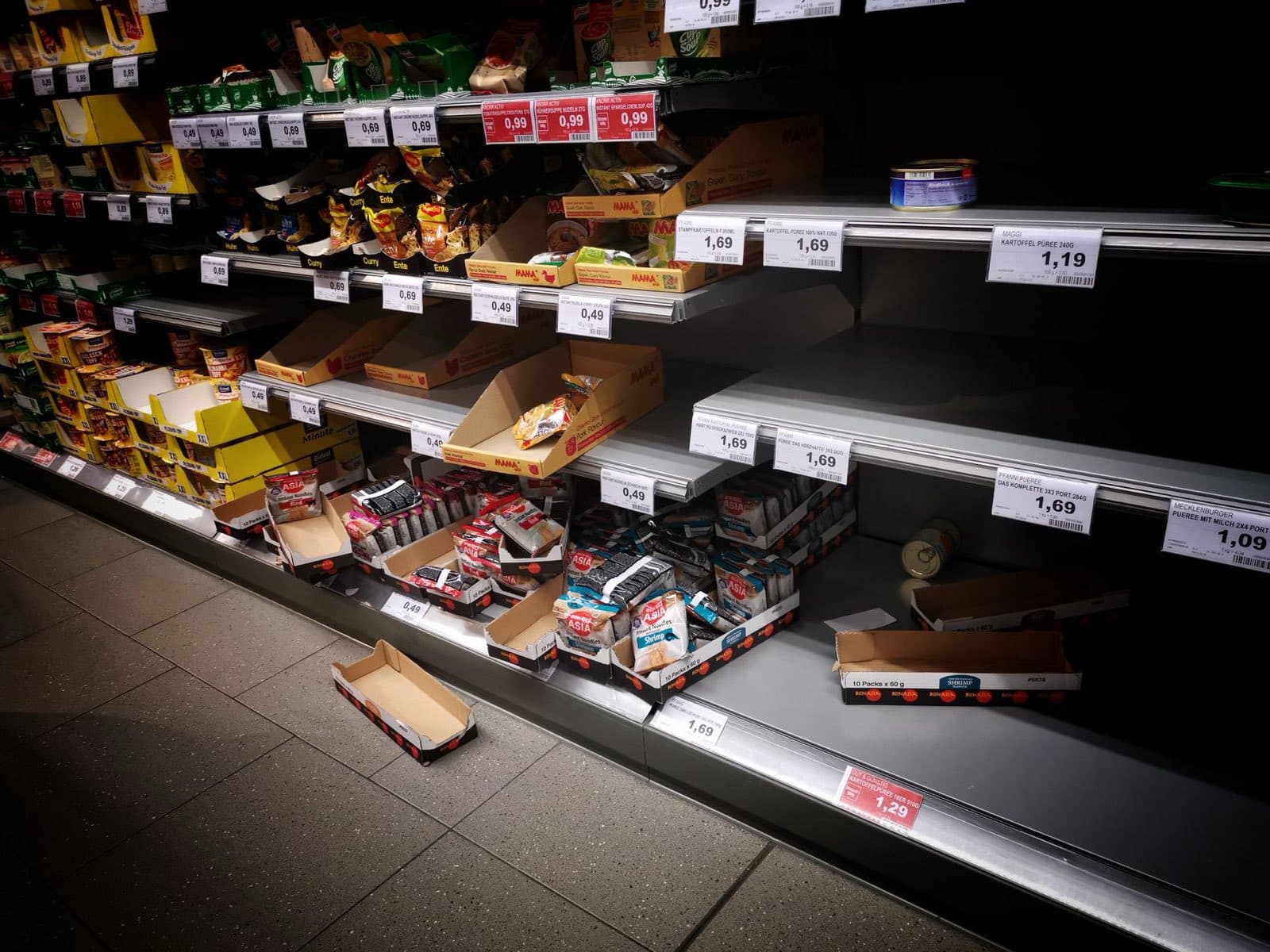 Scenario 13Food Shortage
 Scenario 12Pandemic
 Scenario 07Grid Failure34 scenarios, one libraryBrowse them all →
Go deeper: 1-Month Supply Plan for 4 People · Food Storage Calculator
Historical framing draws on documented US downturns from 1929 to 2008. Nothing on this page is investment advice; it is household logistics, which is the part families control directly. Photography: NASA image library and Pexels, used under their respective licenses.