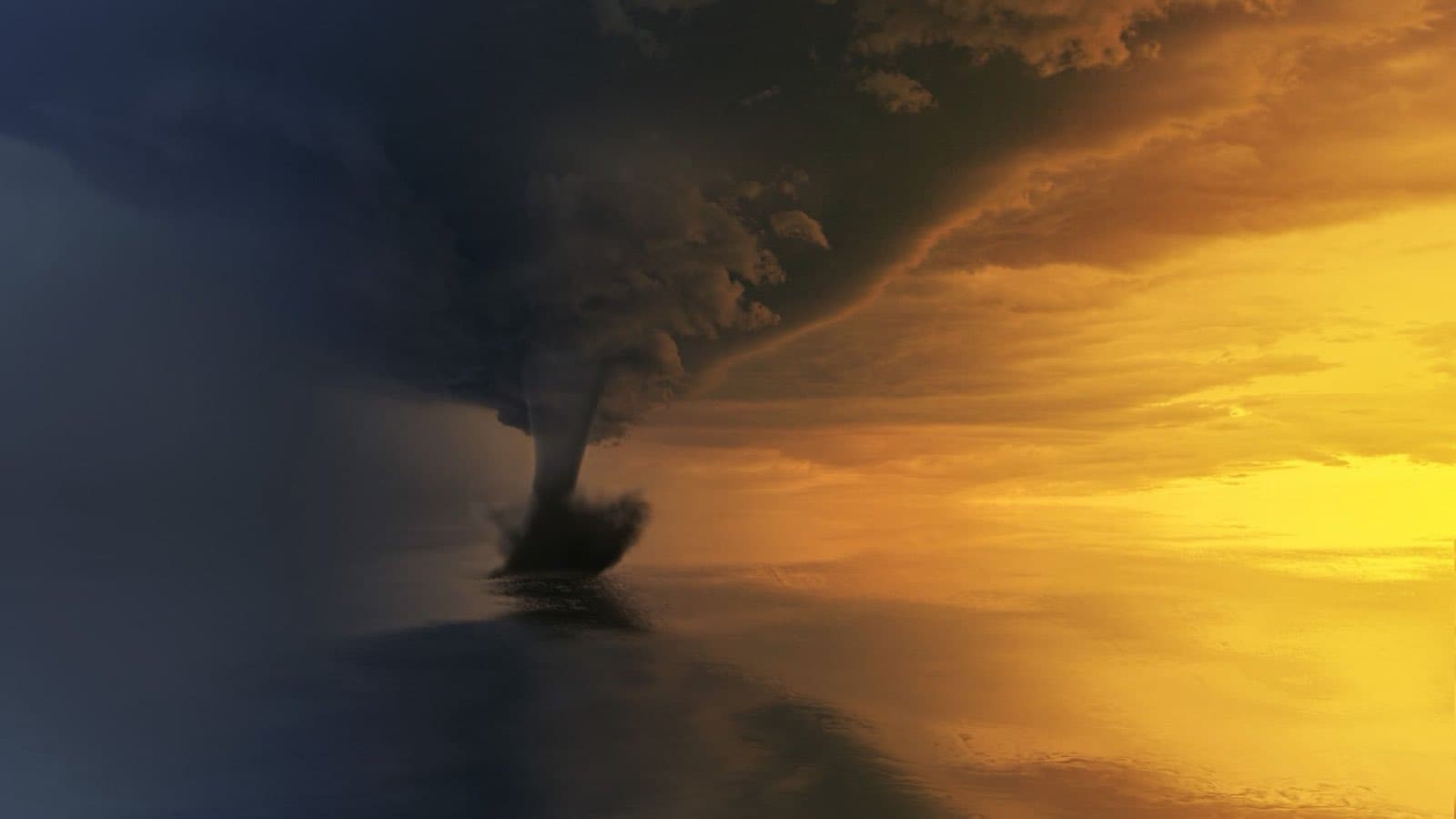
Quick answer
A tornado is a 13-minute event with a 3-day aftermath. You need two things: a rehearsed safe spot with helmets, shoes, and light already inside it, and 3 days of water, no-cook food, and power for the blackout that follows. The safe spot costs you one Saturday hour to set up. Set it up before the season, not during the warning.
Supply numbers are set for 4 people. Change your household size below and every quantity updates.
13 min
Average warning lead time
Lowest floor
Interior room, no windows
3 days
Aftermath supply target
EF0 to EF5
Damage scale, wind speed
How a tornado day actually unfolds
Morning · Outlook
The Storm Prediction Center flags your area as enhanced or moderate risk. That word in the forecast is your setup signal: charge things, clear the safe spot, park the car outside the tree line.
Afternoon · Watch
Tornado watch means conditions are ripe for hours. Life continues, but shoes stay on, phones stay charged, and the weather radio stays on the counter.
The warning
Sirens and phone alerts give you minutes, not hours. Everyone walks to the safe spot, helmets on, and you wait it out. It is loud, then it is quiet.
After
Debris, downed lines, and often days without power across the area. Sturdy shoes and work gloves matter more than anything else in the first hour.
Your household's number
What do those 3 days take for your house?
The figures above are sized for a typical household. Set yours and you'll get the calories, gallons of water, and what they cost for your people. About a minute, no signup.
Food and water calculator
How much food and water does your household need?
Adults
Children
For how long
You'd need
21,000calories
plus 12 gallons of water, around $40 to buy.
For 2 adults, 2 children, 3 days.
That's the target. Provision Planner counts what you already have and shows you what's left to buy.
See how close you arePlay it out
One loud afternoon, three decisions
An enhanced-risk day in April, played honestly. Pick what your household would actually do.
Scene 1 of 3
Saturday, 10am. The forecast says enhanced risk of severe storms this evening. The sky is blue, the lawn needs mowing, and the safe spot under the stairs is currently a coat closet.
Prefer to read it straight through?
Scene 1
Saturday, 10am. The forecast says enhanced risk of severe storms this evening. The sky is blue, the lawn needs mowing, and the safe spot under the stairs is currently a coat closet.
If you it's always enhanced something. mow the lawn: Fair, most risk days pass quietly. But tonight the watch goes up at 6, and you'll be excavating the closet by phone light while the sirens warm up. It all works, just at triple the heart rate.
If you take one hour: clear the closet, stage helmets, shoes, water, and a lantern in it: The safe spot is ready by 11am and the rest of Saturday is completely normal. If nothing happens tonight, it stays ready for the next time. Setup while calm is the entire game.
Field note: The average tornado warning gives 13 minutes. A safe spot you can walk into beats one you have to build while the siren is running.
Scene 2
7:40pm. Tornado warning, your county. The kids are in the safe spot. Your phone says the circulation is 15 minutes out, and you realize you have no idea where the cat is.
If you search the house for the cat: Everyone has done it. But a warning is the one window where minutes are the whole budget, and the cat is statistically under a bed being fine. The house search costs you the calm entry and sometimes the window itself.
If you call once from the safe spot, leave the door cracked, stay put: Cats outlive tornadoes in astonishing numbers; they are small, low, and hide well. Yours strolls in at 7:52 like nothing happened. You were where you needed to be the whole time.
Field note: Shelter discipline is the highest-value habit in tornado country: people who go looking for pets, phones, or one more window video give away the minutes the warning bought them.
Scene 3
8:05pm. It missed you by two miles. Power is out across town, trees are down on your street, and a neighbor is already outside in flip-flops looking at a snapped fence post.
If you head out in whatever is on your feet: The most common post-storm injury is not the tornado, it is stepping on debris in the dark. Flip-flops meet a nail before the adrenaline wears off. You'll be fine, but urgent care is a long drive tonight.
If you boots, gloves, headlamps, then out to check on the street: You look mildly overdressed for fence inspection and entirely right for it. You help two neighbors move a limb, nobody bleeds, and the lanterns make your porch the gathering point.
Field note: After a tornado, treat every dark lawn as a hardware store spilled on the ground: nails, glass, and live lines. Sturdy shoes are the cheapest injury insurance that exists.
The tornado checklist
People in your household
One page per scenario: quantities resize in place, and the link you share always shows this plan.
Your head start
0 of 3 days covered
0 of 13 essentials on hand
Tick what you already own.Save this as your real plan →Supplies buy you days. Gear keeps those days livable. Most families discover they start around day 3.
| Item | For 4 people | Why it matters | Covers | |
|---|---|---|---|---|
| In the safe spot, year-round | ||||
| Bike or sports helmets | 4 helmets | Head injury from flying debris is the main tornado risk. Any helmet counts. | Critical | |
| Hard-soled shoes, old pairs | 4 pairs | You shelter barefoot at 8pm, you walk out over glass at 8:15. | Critical | |
| Battery lantern and headlamps | 1 lantern + headlamps | The power usually drops before the storm arrives. | Critical | |
| Whistle | 1 | Three sharp blasts carry farther than a voice if debris blocks the door. | Safe spot | |
| Water · 12 gallons total | ||||
| Bottled water, 24-pack cases | 3 cases (about 7 gal) | Sealed, portable, splits between rooms and the car. | All days | |
| 5-gallon water jugs | 1 jug | The cheapest gallons you can store. Fill spares before the event, not during. | Backup | |
| Water purification tablets | 1 pack | Turns suspect tap or tub water into drinking water after day 3. | Backup | |
| Food, no cooking required | ||||
| Canned protein: tuna, chicken, beans | 8 cans | Eats straight from the can when the stove is out. | No cooking | |
| Canned vegetables and fruit | 9 cans | Fluids and vitamins while the fridge is dark. | No cooking | |
| Peanut butter | 1 large jar | 2,650 calories per jar, no prep, kids will actually eat it. | No cooking | |
| Crackers, tortillas, granola bars | 2 boxes plus a dozen bars | The bread aisle empties first. These keep for months instead of days. | No cooking | |
| Oats and shelf-stable milk | 3 cartons plus a canister of oats | Breakfast without power, and the milk needs no fridge until opened. | No cooking | |
| Power, light, and news | ||||
| Flashlights or headlamps | 5 flashlights | One per person plus a spare. Candles start fires in dark houses. | All week | |
| Batteries in every size you use | 2 packs per size | The thing that runs out on day 2 if you guess. | All week | |
| Phone battery banks, fully charged | 2 banks | Your phone is your flashlight, radio, and lifeline. Top the banks up the moment trouble is forecast. | All week | |
| NOAA weather radio, battery or crank | 1 | When cell towers and wifi fail, official updates still reach you here. | All week | |
| Health and documents | ||||
| First aid kit | 1 | Minor injuries spike during cleanup, exactly when help is hardest to reach. | All week | |
| Prescription medications | 14-day supply each | Pharmacies reopen slowly. Ask your pharmacist about an emergency refill before you need it. | 2 weeks | |
| Documents in a waterproof bag | IDs, insurance, cash in small bills | ATMs and card readers die with the power. | Grab and go | |
| Manual can opener | 1 | Most of the calories above are locked inside cans without it. | Critical | |
The first section lives IN the safe spot year-round. The rest covers the blackout that usually follows. Print this page to take it shopping.
In the app
The safe spot is a place. The plan is in the app.
Provision Planner has a built-in Tornado scenario. Add your supplies once and it tells you how many days you would last if the grid stays down, what expires, and what to restock. Live National Weather Service alerts are built in, so watch and warning reach you in the same app as the plan.
Run the tornado scenarioTornado scenario
Water
4 days
Food
6 days
Safe spot gear
2 items missing
NWS alerts for your area
Live
Computed from your real inventory. Updates itself as things expire.
Frequently asked questions
Where is the safest place in a house during a tornado?
The lowest floor, in a small interior room or hallway with no windows: a basement if you have one, otherwise a closet or bathroom near the center of the house. Put as many walls between you and outside as you can.
How much warning does a tornado give?
The national average is about 13 minutes from warning to arrival, and some tornadoes give less. That is why the safe spot is stocked in advance: the warning window is for walking there, not for gathering supplies.
What about mobile homes?
Mobile and manufactured homes are where most tornado fatalities happen, even in weak tornadoes. Identify a sturdy building or community shelter you can reach in minutes, and go at the watch stage, not the warning.
Do windows need to be opened to equalize pressure?
No, that is a myth. Opening windows wastes warning minutes and invites debris. Walls and distance from glass are what protect you.
Explore more scenarios
Every scenario gets the same treatment: the event, the supplies, the timeline, and your number.
 Scenario 06Power Outage
 Scenario 01Hurricane
 Scenario 17Shelter in Place
 Scenario 15House Fire
 Scenario 05Extreme Heat34 scenarios, one libraryBrowse them all →
Go deeper: 3-Day Supply Plan for 4 People · Food Storage Calculator
Shelter guidance follows NOAA, the Storm Prediction Center, and Ready.gov. Supply targets follow FEMA planning guidance. This is general planning guidance: adjust for your home's layout and your household's needs. Photography: NASA image library and Pexels, used under their respective licenses.