The Winter Power Outage Checklist for a Small Business
September 24, 2026 · 4min read · Reviewed against FEMA & CDC guidance
A household winter checklist assumes somebody is home. A small business often has the opposite shape: a building sitting cold and empty through a long weekend while a storm moves over it, and nobody finds out what happened until Tuesday morning.
That's the version worth planning for. If you want the general business kit, the hurricane supply list for a small business covers the parts that apply to any storm: cash in small bills, a paper way to take a sale, first aid sized to your head count, a printed contact order. This one sticks to what only winter does.
Below 55 degrees, the building starts costing you money
The expensive winter claim at a small business is almost never the lost day of trade. It's water.
Once the heat is off and the indoor temperature slides under roughly 55°F, pipes start to be at risk. The runs in crawl spaces, unheated back rooms and along outside walls go first, because they were never really protected in the first place. One burst line in a ceiling over a Sunday will do more damage than a week of closure, and by the time anyone notices it has been running for forty hours.
Everything below is downstream of that one fact.
The ten minutes that prevent it
None of this is skilled work and all of it is cheaper than a claim.
Find your water shutoff and write down where it is. Not in your head, and not only in the head of whoever has worked there longest. On a card, by the back door, where a closing staff member can find it at nine at night.
If the building will be empty and the forecast is bad, shut the water off and drain the lines. This is the only item here that removes the risk instead of lowering it. For a long holiday weekend it's worth the twenty minutes.
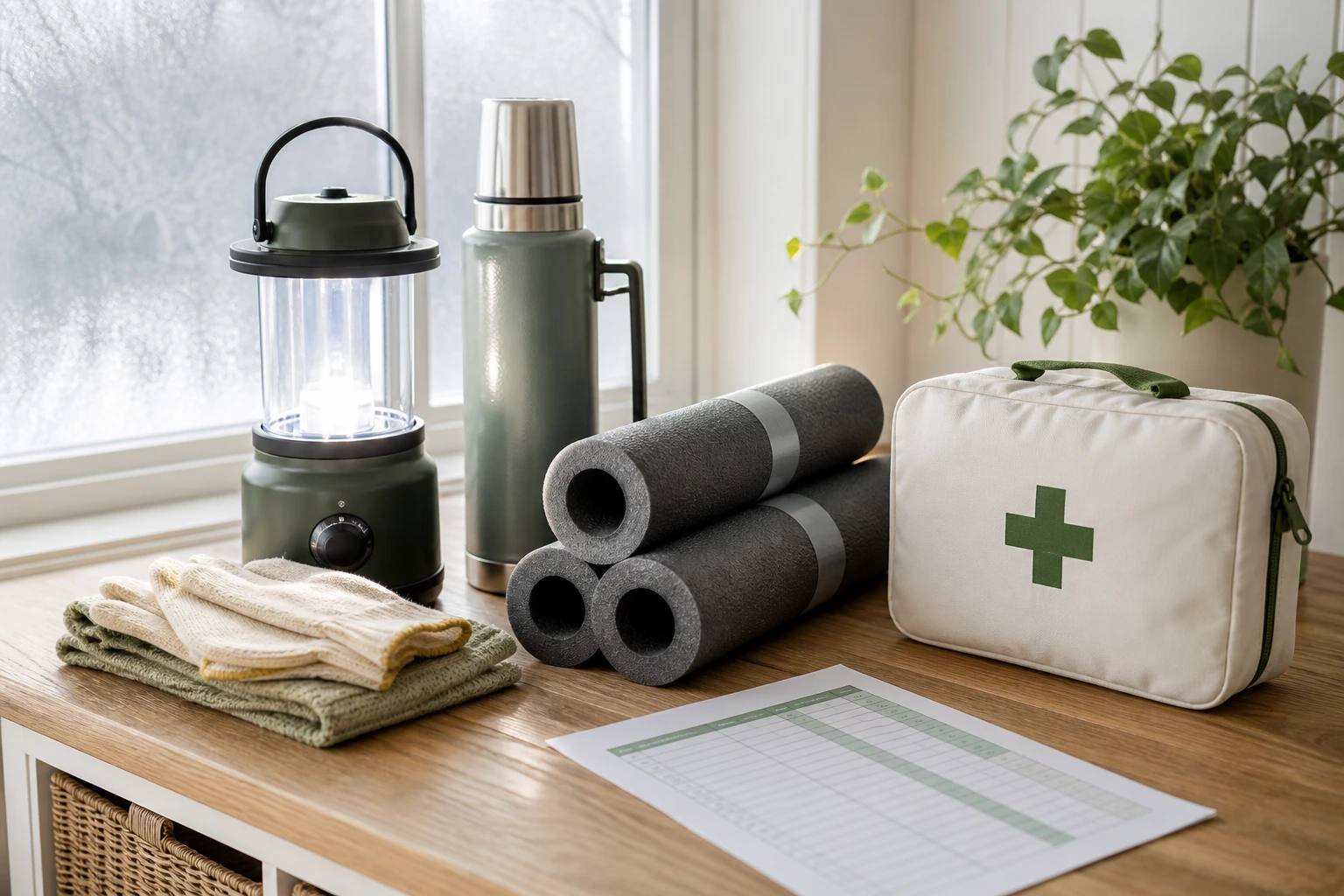
Sleeve the exposed runs. Foam pipe insulation costs a few dollars a length and goes on by hand.
Open the cabinets under the sinks before you lock up, so whatever warmth the room has can reach the plumbing behind them.
Leave one faucet dripping on the coldest nights if the building is heated but empty. Moving water is much harder to freeze than still water.
If the heat fails while people are in the building, you're now running a cold room rather than a business: keep everyone in the smallest space you can heat, keep the outside doors shut, and don't use anything that burns fuel indoors, including a charcoal grill or a camping stove. Carbon monoxide is the thing that actually hurts people in winter outages.
Ice outside your door is a liability question
This is the winter risk that catches owners off guard, because it doesn't feel like an emergency.
In most places you carry a duty to keep your entrance reasonably safe, and that duty doesn't politely wait until the snow stops. A customer going down on your walkway is a bigger problem than a closed day.
Buy the salt or grit in October, because the week everybody needs it is the week the stores are empty. Clear and treat on a schedule instead of when you notice. Then write down what you did and when, and take a photo of the walkway afterwards. If a claim ever comes, the thing that helps you is a boring record showing you made a reasonable effort on a regular basis.
Decide, in September, what makes you close
Winter gives you a decision hurricanes mostly don't: whether to open in the morning. Made at 5 a.m. against a forecast that could still go either way, that call tends to come late, because closing costs real money and nobody wants to be the one who overreacted.
So set the trigger now, while it's warm and the decision is cheap. Something plain: if the county issues a winter storm warning, or the schools close, we close. A written rule lets your staff arrange childcare and travel the night before, and it takes the judgment out of a moment when you'll have the least appetite for it.
The checklist worth sending your own customers
If you're in a trade people lean on during a cold snap, heating, plumbing, property management, home services, the storm is also the week your phone stops being usable.
A short list sent to your customers before the season does two useful things at once. It genuinely helps them, and it clears the easy calls off your line so you can reach the people with an actual emergency. Keep it to the moves that prevent damage:
- Know where your water shutoff is
- Keep the thermostat at 55°F or above, even when you're away
- Open the cabinet doors under sinks on the coldest nights
- Let one faucet drip
- Disconnect and drain outside hoses before the first freeze
- Never run a generator, grill or camp stove indoors or in the garage
Six lines, sent in October. The people who read it won't be the ones calling you at midnight in January, and the ones who do call will have a real problem.
The list stops being true by about February
Every supply list is accurate the day it's written and then quietly drifts. The salt gets used up during a cold snap in November and nobody replaces it. Lantern batteries migrate into somebody's remote. The shutoff card gets filed somewhere sensible and then forgotten.
Provision Planner exists to stop that drift. It holds the count for you and flags what has run down, so the list stays true in February without anyone auditing it. Run the winter storm scenario in October, while there's still time to order what's missing. That's the one point in the year when finding a gap is useful rather than just annoying.
Frequently asked questions
- How cold can a building get before the pipes freeze?
- Pipes start to be at risk below about 55°F indoors, and unheated spaces and runs along exterior walls go first. In a building with no heat at all, hard cold can get you there inside a day. Shutting the water off at the main and draining the lines ends the risk rather than reducing it.
- Should a small business close during a winter storm?
- Decide the rule before the season rather than during the storm. A common one is that if the county issues a winter storm warning or the schools close, you close. Staff can plan around a written rule, and it takes the pressure off making an expensive call at 5 a.m. while the forecast is still uncertain.
- Who is liable if a customer slips on ice outside my business?
- In most places the occupier carries a duty to keep the entrance reasonably safe, and that duty does not wait for the storm to finish. Clear and treat on a schedule, write down when you did it, and photograph the walkway afterwards. The record of reasonable effort is what matters if a claim comes.
Food and water calculator
How much food and water does your household need?
Adults
Children
For how long
You'd need
98,000calories
plus 56 gallons of water, around $185 to buy.
For 2 adults, 2 children, 2 weeks.
That's the target. Provision Planner counts what you already have and shows you what's left to buy.
See how close you areYou did the reading. Now get your number.
Provision Planner does this article's math for your real household, automatically, and keeps it current as supplies come and go.