The Hurricane Supply List for a Small Business
September 23, 2026 · 4min read · Reviewed against FEMA & CDC guidance
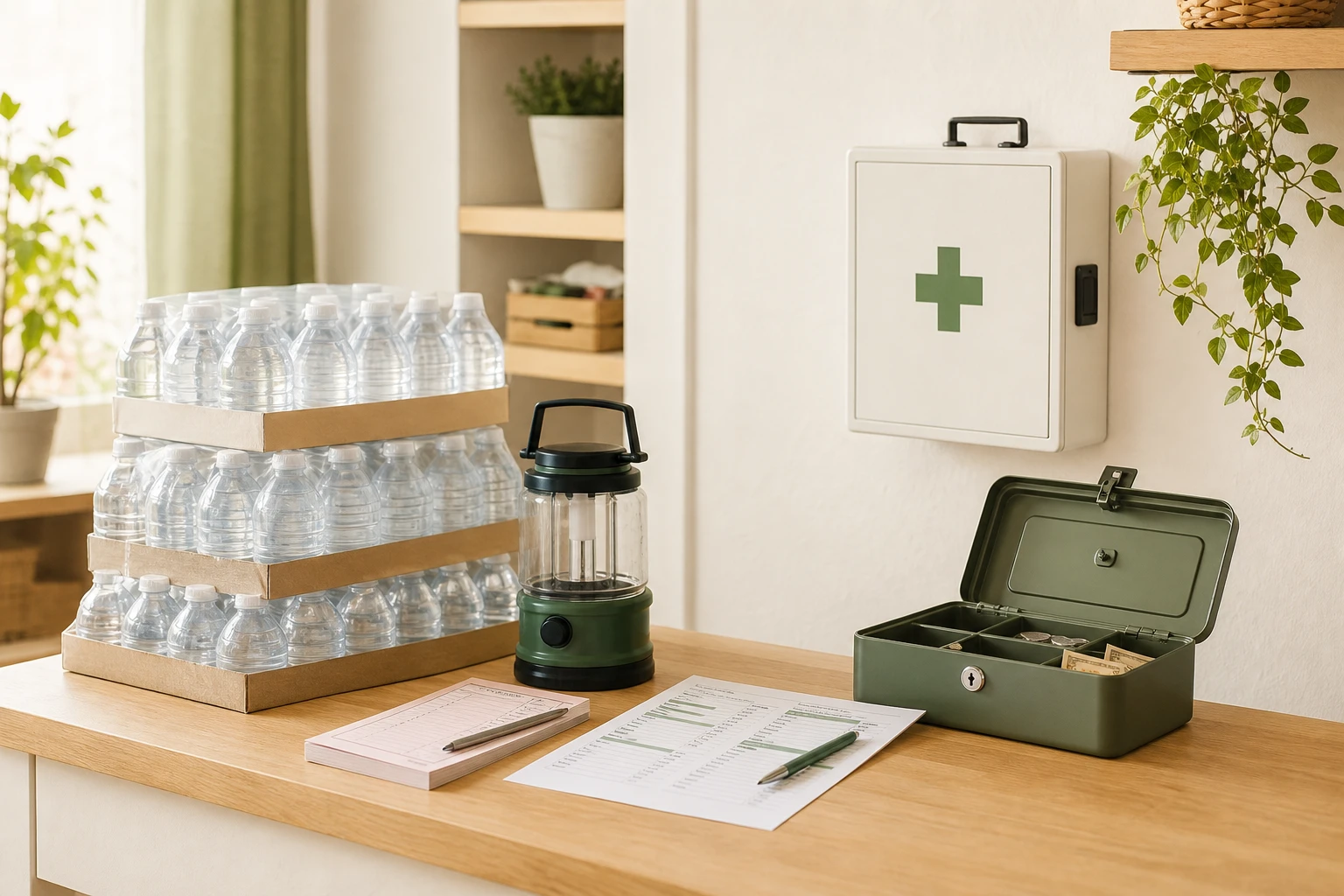
Almost every hurricane checklist is written for a family at home. A business has the same problems multiplied by head count, plus a set of its own that no household list mentions: records, payroll, stock, and the question of whether you're open tomorrow.
This is the second list. It assumes you've already worked through the household hurricane supplies list, and it covers what that one leaves out.
Everything scales off your head count
The arithmetic is the same as at home and the number is bigger. One gallon of water per person per day, counting everyone who could plausibly be on site: staff on shift, staff who can't get home, and in some trades the customers who end up sheltering with you.
A shop with six employees planning for three days needs 18 gallons before anyone has washed anything. A restaurant kitchen in August needs considerably more, because the work is hot and physical. Food follows the same logic: shelf stable, no cooking required, roughly 2,000 calories per person per day, and enough of it that nobody is deciding between going home through a storm and going hungry.
Most businesses underestimate this because they picture the storm arriving during a quiet shift. Plan for the busy one.
The supplies a household list skips
A first aid kit sized for your head count, not the twelve-bandage box behind the register. If you have more than ten staff, you want two, kept in different parts of the building.
Cash in small bills. Card readers need power and a connection, and in the days after a storm you may be the only place on the block that can still take money. Small bills matter because nobody will have change.
Battery lanterns rather than flashlights for anywhere staff need to work with their hands. A flashlight gets you across a dark stockroom and then becomes useless the moment somebody needs both hands free.
A manual way to record a sale. A carbon-copy receipt book and a pen sounds quaint right up until the afternoon your point of sale system is a brick and you're turning away customers you could have served.
Fuel, drawn early. For a generator if you have one, and for any vehicle you'd need to move stock or staff. Stations back up and then run dry, usually in that order.
Plastic sheeting, tape and sandbags sized to your actual openings. Measure the doors now rather than guessing in a hardware store that's already been stripped.
The records are the part people lose
Stock is what insurance is for. The paperwork proving the stock was ever there tends to live in one folder, on one shelf, with no copy anywhere.
Before the season, not before the storm: photograph everything. Walk the place with your phone and record it. Open the cabinets, get the equipment, get the serial numbers on the expensive things. Insurers settle far faster against footage than against a written list made from memory after the fact.
Then get the paperwork off site. Insurance policy, lease, supplier contacts, payroll details, licenses. Somewhere in the cloud and somewhere on paper in another building. The version of you that needs these won't have power or, possibly, a building.
Decide the closing rule in advance
The hardest call in a storm is when to close. Made in the moment it's emotional and usually late, because closing costs money and the forecast is never certain enough.
So write the rule down when it's sunny. Something as plain as: when a watch becomes a warning, we close, we send everyone home, and the last person out works the shutdown list. Staff can plan around a rule. They can't plan around you deciding at 4 p.m.
The same goes for the contact order. Who calls whom, in what sequence, and what the fallback is when the cell network is jammed. Agree on it, print it, and put a copy in more than one person's bag.
Reopening is where the money is
For most small businesses the whole game is the Wednesday afterwards, with the block still dark and your doors open.
That usually comes down to unglamorous things. Cleaning supplies and heavy contractor bags. A wet/dry shop vac. Spare bulbs and fuses. Enough of whatever you actually sell to have something on the shelves. The competitor who spent the storm worrying and the one who spent it with a list both reopen eventually, and the customers mostly go to whoever is first.
Keeping the list honest between seasons
The problem with any supply list is that it's accurate on the day you write it and slowly stops being true. Water gets drunk, batteries get borrowed for something else, the first aid kit quietly loses its scissors.
Provision Planner keeps the count live instead of on paper. Set your head count, add what's actually in the building, and it tells you how many days you're covered for rather than how many items you have. Check the hurricane scenario in June and the gaps show up while there's still time to order something, which is the only useful time to find them.
Frequently asked questions
- How much water should a business store for a hurricane?
- One gallon per person per day, counting everyone who could be on site, not just staff on shift. A shop with six employees planning for three days needs 18 gallons at minimum, and more if customers may shelter with you or if your work is physical.
- What should a small business do before a hurricane?
- Photograph everything you own, back up records somewhere off site, draw cash in small bills, fuel any generator and vehicles, agree on a staff contact order, and decide in advance at what point you close. Deciding while the forecast is still uncertain is far easier than deciding at 2 a.m.
- How long should a business be prepared to operate without power?
- Plan for three days as a floor and a week as a realistic ceiling in a bad storm. For most small businesses the goal is to protect stock, keep staff safe and reopen ahead of the competition, rather than to trade through the storm itself.
Food and water calculator
How much food and water does your household need?
Adults
Children
For how long
You'd need
98,000calories
plus 56 gallons of water, around $185 to buy.
For 2 adults, 2 children, 2 weeks.
That's the target. Provision Planner counts what you already have and shows you what's left to buy.
See how close you areYou did the reading. Now get your number.
Provision Planner does this article's math for your real household, automatically, and keeps it current as supplies come and go.