Tornado Preparedness: The Checklist for Thirteen Minutes
July 29, 2026 · 4min read · Reviewed against FEMA & CDC guidance
The National Weather Service averages about thirteen minutes of warning before a tornado reaches you. Some warnings give less.
Thirteen minutes is a strange amount of time. It is plenty if the decisions are already made. It is nowhere near enough to find everyone's shoes, hunt for a flashlight, argue about the basement, and fill water bottles. So the whole of tornado preparation is really just moving work out of those thirteen minutes and into an ordinary afternoon like today.
This is the checklist version. If you want the fuller walkthrough of how a tornado unfolds and what happens afterwards, the tornado scenario page covers that ground.
Watch and warning are two different jobs
A watch means conditions are right. Nothing is happening yet. This is when you do things: bring in the patio furniture, charge everything, put shoes by the door, tell the family where you'll go, and if you live in a mobile home, leave.
A warning means one has been spotted or shows on radar in your area. This is when you stop doing things and go to the room.
Mixing these up is the most common mistake, and it usually runs in the direction of treating a warning as a cue to start preparing. By then you are spending your thirteen minutes on tasks that belonged to the watch.
Pick the room now, out loud
Rank the options in your own home:
- Basement or storm cellar, under something sturdy if you can manage it
- A windowless interior room on the lowest floor: bathroom, closet, pantry
- An interior hallway, as far from exterior walls as the house allows
Windows are the thing to get away from, because glass travels. Ignore the old advice about opening them to equalize pressure. That one is wrong, and it costs you a minute you need.
Say the choice out loud to everyone in the house, and walk there once. A room nobody has stood in is a plan nobody will follow at two in the morning.
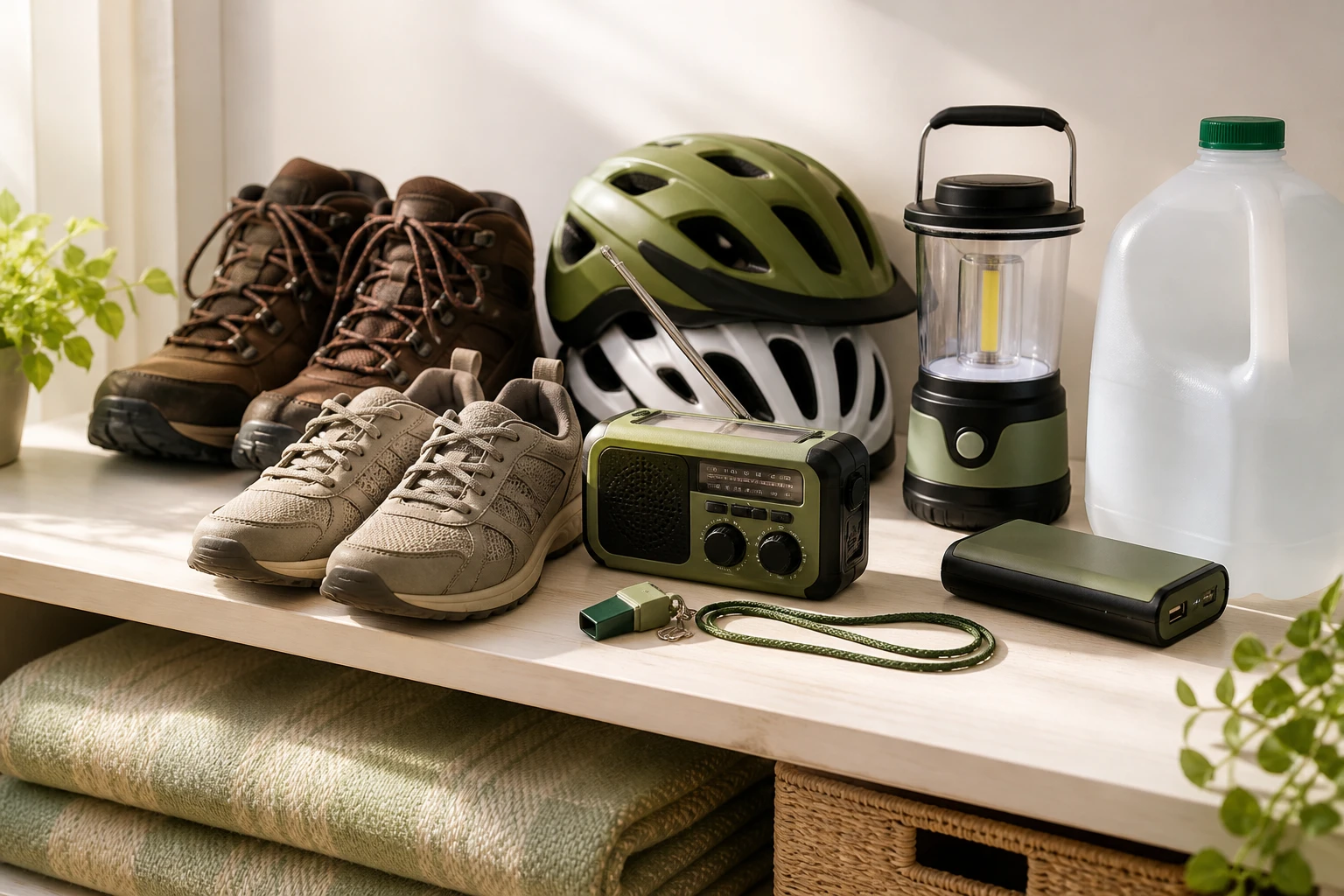
The kit that lives in that room
Not your general emergency supplies. A small, separate set that stays put, because the point is that nobody has to fetch anything.
| Item | Why it earns the space |
|---|---|
| Sturdy shoes, one pair per person | Broken glass and nails are what injure people afterwards, not during |
| Bike or sports helmets | Head injury is a leading cause of tornado deaths. Helmets are cheap and they work |
| Battery or crank weather radio | Your phone may have signal. It may not. The radio does not care |
| Flashlight or lantern per person | Not candles. Gas lines break |
| A loud whistle | If a house comes down, a whistle carries much further than a voice |
| Water, 1 gallon per person | You may be in there a while, or unable to leave the property afterwards |
| Phone battery pack, charged | Charge it when a watch is issued, not when it's needed |
| Copies of insurance and ID | Or the emergency binder if you keep one |
Helmets and shoes are the two most-skipped items on any tornado list, and they are the two that injury data actually supports. They look slightly ridiculous sitting in a closet. That is fine.
If you live in a mobile home
Leave during the watch. Not the warning.
Manufactured housing does not survive tornadoes, including weak ones, and tie-downs do not change this. The honest plan is knowing in advance which sturdy building or community shelter you will go to, how long the drive takes, and who is driving. Then going when a watch is issued and feeling a bit silly about it on the many occasions nothing happens.
That feeling of over-reacting is the entire cost of the plan working.
After it passes
Stay put for a few minutes. Second cells follow first ones more often than people expect.
Then: shoes on before you move anywhere, check people before property, and assume every downed line is live. Photograph the damage before you touch anything, because insurers settle much faster against footage than against a description written a week later.
Gas smell means out of the house first, phone calls second.
The part a checklist can't do
Closets drift. Six months from now the batteries in the weather radio are flat, somebody borrowed the flashlight for the car, the helmets got moved when the closet was reorganized, and the water was drunk during a power cut in July. Nobody notices any of it, because there is no reason to look.
That drift is what Provision Planner is built against. You record what is genuinely in the house, and it converts that into days of coverage for your household size. Open the tornado scenario at the start of the season and the holes surface in March, when replacing something is an errand instead of a problem.
Thirteen minutes is enough. It just has to be thirteen minutes of walking to a room, not thirteen minutes of deciding.
Frequently asked questions
- How much warning do you get before a tornado?
- The National Weather Service averages roughly 13 minutes of lead time on a tornado warning, and some warnings give considerably less. That number is the reason preparation has to be done in advance. Thirteen minutes is enough to move people to a room you already chose, and not enough to find shoes, fill water bottles and decide where to go.
- Where is the safest place in a house during a tornado?
- The lowest floor, in the most interior room, with as many walls between you and the outside as possible, and no windows. A basement is best. Without one, a windowless bathroom, closet or hallway near the center of the house is the usual choice. Bathrooms have the small advantage of plumbing in the walls, which adds a little structure.
- Is a mobile home safe in a tornado?
- No, and this is the one piece of tornado advice that has no nuance. Manufactured homes are not survivable in even a weak tornado regardless of tie-downs. The plan has to be leaving for a sturdy building or a community shelter when a watch is issued, not when a warning comes, because a warning does not leave enough time to drive anywhere.
Food and water calculator
How much food and water does your household need?
Adults
Children
For how long
You'd need
98,000calories
plus 56 gallons of water, around $185 to buy.
For 2 adults, 2 children, 2 weeks.
That's the target. Provision Planner counts what you already have and shows you what's left to buy.
See how close you areYou did the reading. Now get your number.
Provision Planner does this article's math for your real household, automatically, and keeps it current as supplies come and go.