Prepping With Kids: Readiness Without the Fear
August 13, 2026 · 4min read · Reviewed against FEMA & CDC guidance
"Is that going to happen to us?"
Children ask it directly, usually after a news clip, and usually while you are doing something else. The answer that works is neither reassurance nor a lecture. It's a job.
Fear in children comes mostly from having no part to play. A child who knows the plan, and knows their piece of it, generally handles the whole subject better than one who has only been told what might go wrong. That single idea shapes everything below.
Give every child a job
Real ones, sized to the child.
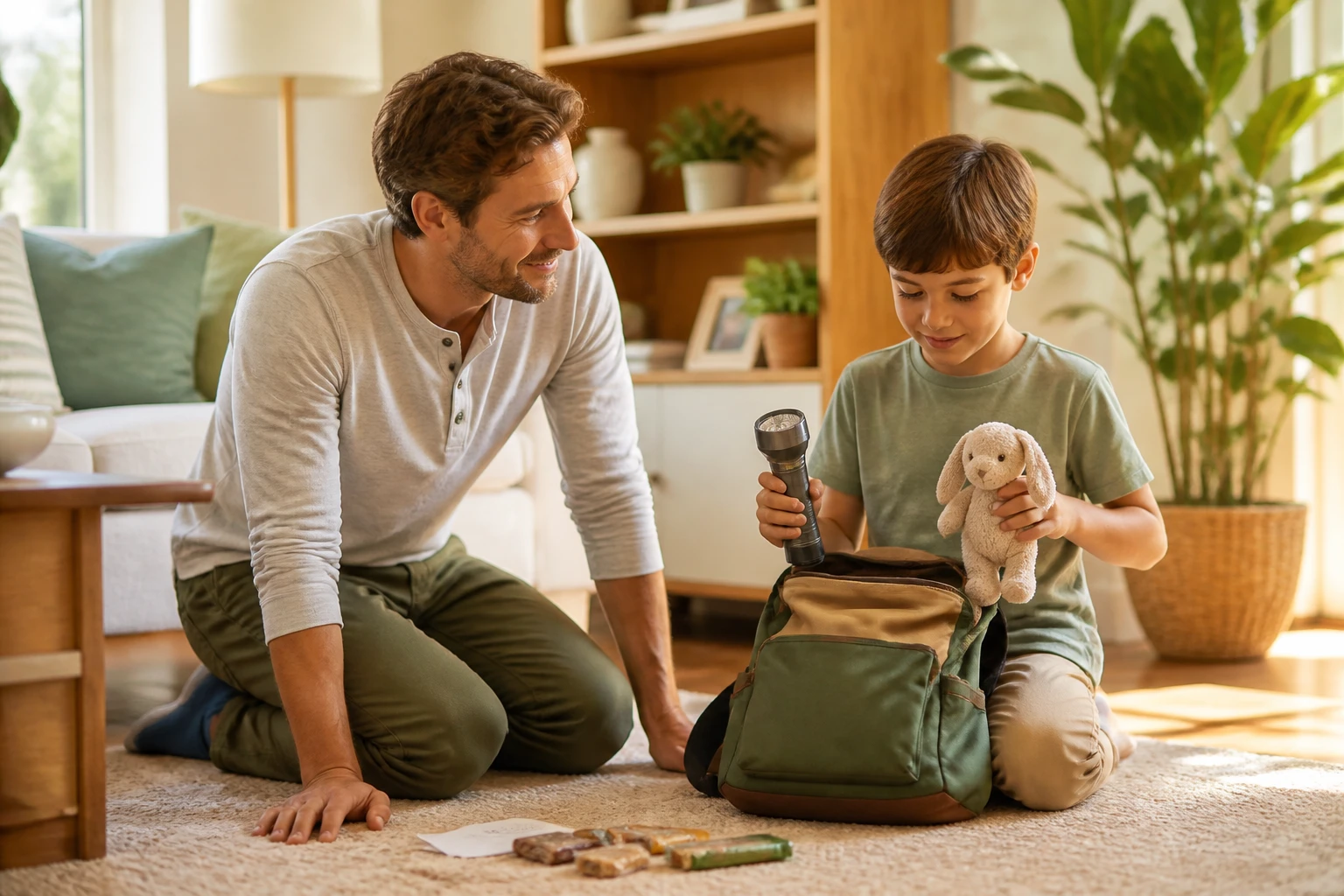
A four-year-old can be the person who carries the torch. A seven-year-old can be in charge of the pet's bag, which they will take startlingly seriously. A ten-year-old can be the one who counts heads at the meeting spot. A teenager can be genuinely useful: filling water containers, minding younger siblings, knowing how to shut off the gas.
Jobs do two things at once. They turn a frightening abstraction into a task with a beginning and an end, and they mean that during an actual emergency you are not managing a frightened child while also managing everything else.
What they should know by heart
Phones die, and a child separated from you has whatever is in their head.
| Age | What to work on |
|---|---|
| 3 to 5 | Their full name, your full name, and that a firefighter or a police officer is a safe person to ask |
| 5 to 7 | Your mobile number, home address. Numbers set to a tune stick far better than numbers recited |
| 7 to 10 | The out of state contact's name and number, where the family meeting spot is |
| 10+ | How to text if calls won't connect, where the go bags live, how to reach the second meeting spot alone |
The out of state contact is the piece adults tend to skip. During a regional emergency, local networks jam almost immediately while long distance calls often still go through, so a relative three states away can relay messages when nobody in town can reach each other. Pick one, tell them they've been picked, and have everybody learn the number.
Write the same details on a card in their bag anyway. Memory and paper cover different failures.
Practise it like a fire drill
Schools run fire drills constantly, and no child is traumatized by them, because they're routine, brief, and everyone knows what's coming.
Do the same thing. Twice a year, announce it, walk to the meeting spot, time it, and make some fuss about beating the last time. Younger children can do a torch hunt in the dark. Older ones can be handed a scenario and asked what they would do, which frequently produces better answers than yours.
Keep it short and keep it light. The point is that the route is familiar, not that anyone feels the weight of why.
Let them pack their own bag
An adult-packed kit is a bag a child carries. A child-packed kit is a bag a child owns, and the difference shows the first time they need it.
Give them the list and a hand: clothes, a torch of their own, snacks they genuinely like rather than the sensible ones, the contact card, and whatever comfort item they choose. Then leave the choices alone, even the odd ones. The value is in it being theirs.
There is a fuller list in the 72-hour kit checklist if you want a starting point, though for children I'd hand them the short version and let them argue with it.
The comfort item does real work
A stuffed rabbit is not a sentimental extra in a kit. For a young child in a strange room after a bad night, it is the most functional thing in the bag.
Buy a second one if the item is irreplaceable and the child is small. Parents who have done this describe it as the best few pounds they ever spent.
When they ask if it's going to happen
Answer the question they asked, at the size they asked it.
Something close to: probably not, and we'd know what to do. Then stop. The instinct to keep explaining is where most of the damage gets done, because a long answer signals that the question was a big one.
If they press, be honest that you don't know, and immediately come back to the plan. Children are reassured by competence far more than by promises, and they are quicker than adults at spotting the difference.
Two things to avoid: the news on a loop, and preparing in front of them while visibly anxious. They read the second one much more accurately than we'd like.
Keeping it real as they grow
The complication with children is that everything you set up expires. The number they memorized was for a phone you replaced. The clothes in the bag stopped fitting a year ago. The jobs you assigned suit a child two birthdays younger. The plan quietly becomes a plan for a family that no longer exists.
Provision Planner tracks the household you have now, children included, and works out how many days your actual supplies cover for that actual number of people. Add a child and the target changes on its own. It's the difference between a plan made once and a plan that keeps up.
Do a round of it each time somebody has a birthday. It takes about ten minutes and it catches nearly everything.
For infants specifically, the numbers work differently enough that emergency preparedness with a baby covers it separately. And if you haven't written the household plan itself yet, one evening is genuinely enough.
Frequently asked questions
- How do you teach kids about emergencies without scaring them?
- Give them something to do. Fear comes mostly from helplessness, so a child with a job in the plan tends to feel steadier than one who has only been told what might happen. Keep the framing practical and matter of fact, practise the same way you practise a fire drill, and answer questions honestly at the size they were asked.
- What should a child memorize for an emergency?
- A parent's full name and mobile number, their home address, and the name and number of one out of state contact. Most children can manage the phone number around age five or six with repetition, often through a song. The out of state contact matters because local phone networks jam during a regional emergency while long distance calls frequently still connect.
- What should be in a child's emergency kit?
- A comfort item they chose themselves, a change of clothes, a small torch of their own, snacks they actually like, a card with the memorized contact details written down, and any medication. The comfort item is not a nice extra. For a young child it does more work in the first hour than anything else in the bag.
Food and water calculator
How much food and water does your household need?
Adults
Children
For how long
You'd need
98,000calories
plus 56 gallons of water, around $185 to buy.
For 2 adults, 2 children, 2 weeks.
That's the target. Provision Planner counts what you already have and shows you what's left to buy.
See how close you areYou did the reading. Now get your number.
Provision Planner does this article's math for your real household, automatically, and keeps it current as supplies come and go.