How to Can Water: The Mason Jar Method That Never Needs Rotating
July 16, 2026 · 4min read · Reviewed against FEMA & CDC guidance
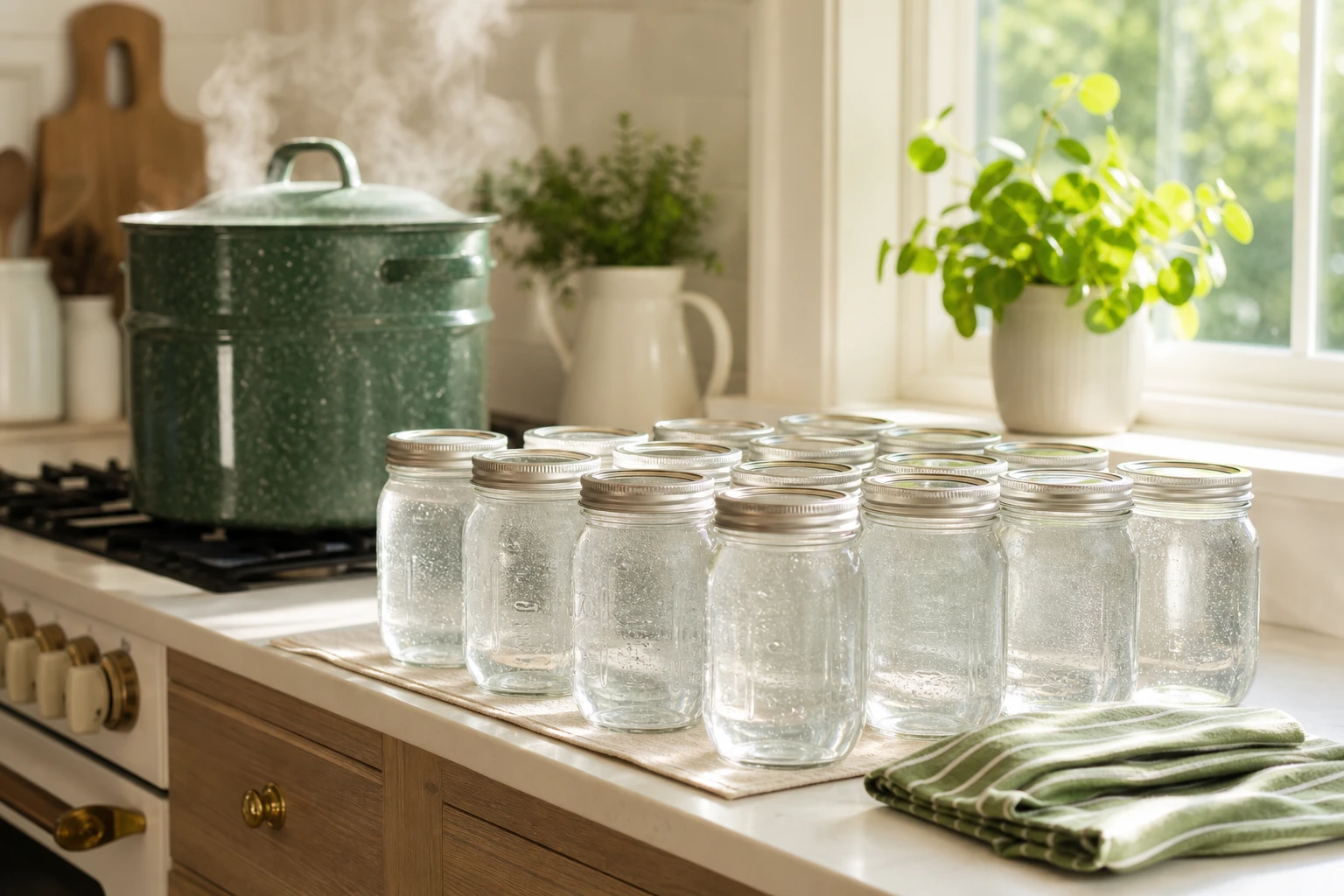
If you already own a water bath canner, you own a water storage system that never needs rotating. Every empty canner load and every spare shelf of mason jars can become sealed, sterile drinking water that keeps indefinitely.
Here is the short version: fill clean quart jars with boiling water, leave 1/2 inch of headspace, apply two-piece lids, and process in a boiling water bath for 20 minutes. The jar cools, the lid pings, and the water inside is sealed under vacuum. No 6-month rotation, no plastic taste, no wondering what leached out of the jug during a hot summer in the garage.
Why can water at all?
Water stored in plastic containers is safe but not maintenance-free. The CDC recommends replacing self-filled containers every 6 months, because containers get opened, plastic breathes, and sanitizing is never perfect. Most families skip the rotation, which is how a water shelf quietly becomes a question mark.
Canned water removes the maintenance:
| Method | Shelf life | Rotation work | Cost per gallon |
|---|---|---|---|
| Self-filled jugs | 6 months | Empty, sanitize, refill twice a year | Cheap, recurring effort |
| Store-bought bottled | 1 to 2 years by date | Replace by date | Moderate |
| Canned in mason jars | Indefinite while sealed | Check seals yearly | Nearly free after jars |
Glass also wins on purity. Nothing migrates into the water, and the boiling water bath sterilizes both the water and the jar in one step.
What you need
- Mason jars, quart or half-gallon, with new or undamaged two-piece lids
- A water bath canner or any deep stockpot with a rack
- Clean tap water from a source you trust today
That last point matters: canning preserves the water you put in. Start with municipal tap water or well water you already drink. If your source is questionable, disinfect it first using the methods in our emergency water purification guide.
The steps
- Wash the jars in hot soapy water and rinse well. They do not need separate sterilizing, because the processing time handles it.
- Boil your water in a large pot. One minute at a rolling boil is the CDC's disinfection standard.
- Fill the hot jars, leaving 1/2 inch of headspace at the top.
- Wipe the rims with a clean cloth so nothing interferes with the seal.
- Apply lids and rings finger-tight. Cranking the ring down traps air and causes seal failures.
- Process in a boiling water bath for 20 minutes, with jars covered by at least an inch of water.
- Cool for 12 to 24 hours, then check each seal by pressing the lid center. No flex means sealed.
- Remove the rings, label with the date, and store in a cool, dark place.
A jar that fails to seal is not wasted. Use it in the kitchen and re-process the jar with a fresh lid.
The efficient habit: whenever your canner runs with empty rack space during food canning season, slot in a couple of water jars. Free water storage rides along with the salsa.
The honest math on volume
This is where canned water earns its real job description. A quart jar holds a quarter gallon, and the standard emergency number is 1 gallon per person per day. Two weeks of drinking water for a family of four is 56 gallons, which would be 224 quart jars. Nobody is canning that.
The workable split: canned jars cover the drinking half of your smallest, most critical need, maybe 2 to 4 gallons per person in jars, while bulk containers cover cooking and hygiene. Our guide on how much water to store for an emergency breaks down the full family numbers, and the water storage containers guide covers the bulk side.
One more caution: glass breaks. If you live in earthquake country, store jars low, in boxes with dividers, never on open high shelves.
The part the jars can't do
Canning water solves the rotation problem for one shelf of your supply. It does not tell you how many days your whole household could actually cover, how your jars, jugs, and bottled cases add up, or when the rest of your storage needs attention.
That running total is what Provision Planner does. Log your water storage once, in whatever mix of jars and jugs you actually own, and it shows you the number that matters: how many days your family is covered, and exactly how many gallons short you are of two weeks.
Frequently asked questions
- Can you really can water in mason jars?
- Yes. Fill clean quart jars with boiling water, leave half an inch of headspace, apply lids, and process in a boiling water bath for 20 minutes. The jar seals under vacuum and the water inside stays sterile until you open it.
- How long does canned water last?
- Indefinitely, as long as the seal holds. Unlike water stored in plastic jugs, which the CDC recommends replacing every 6 months, a sealed glass jar has nothing to leach and nothing to rotate. Check seals once a year and re-process any jar that has let go.
- Is canning water better than storing jugs?
- It is a supplement, not a replacement. A quart jar holds a quarter gallon, so two weeks of drinking water for one person is about 28 jars. Canned water shines as a zero-rotation drinking reserve; bulk containers still do the heavy lifting for cooking and hygiene.
Food and water calculator
How much food and water does your household need?
Adults
Children
For how long
You'd need
98,000calories
plus 56 gallons of water, around $185 to buy.
For 2 adults, 2 children, 2 weeks.
That's the target. Provision Planner counts what you already have and shows you what's left to buy.
See how close you areYou did the reading. Now get your number.
Provision Planner does this article's math for your real household, automatically, and keeps it current as supplies come and go.