How Much Propane Does a Generator Use? Real Tank Math
October 9, 2026 · 3min read · Reviewed against FEMA & CDC guidance
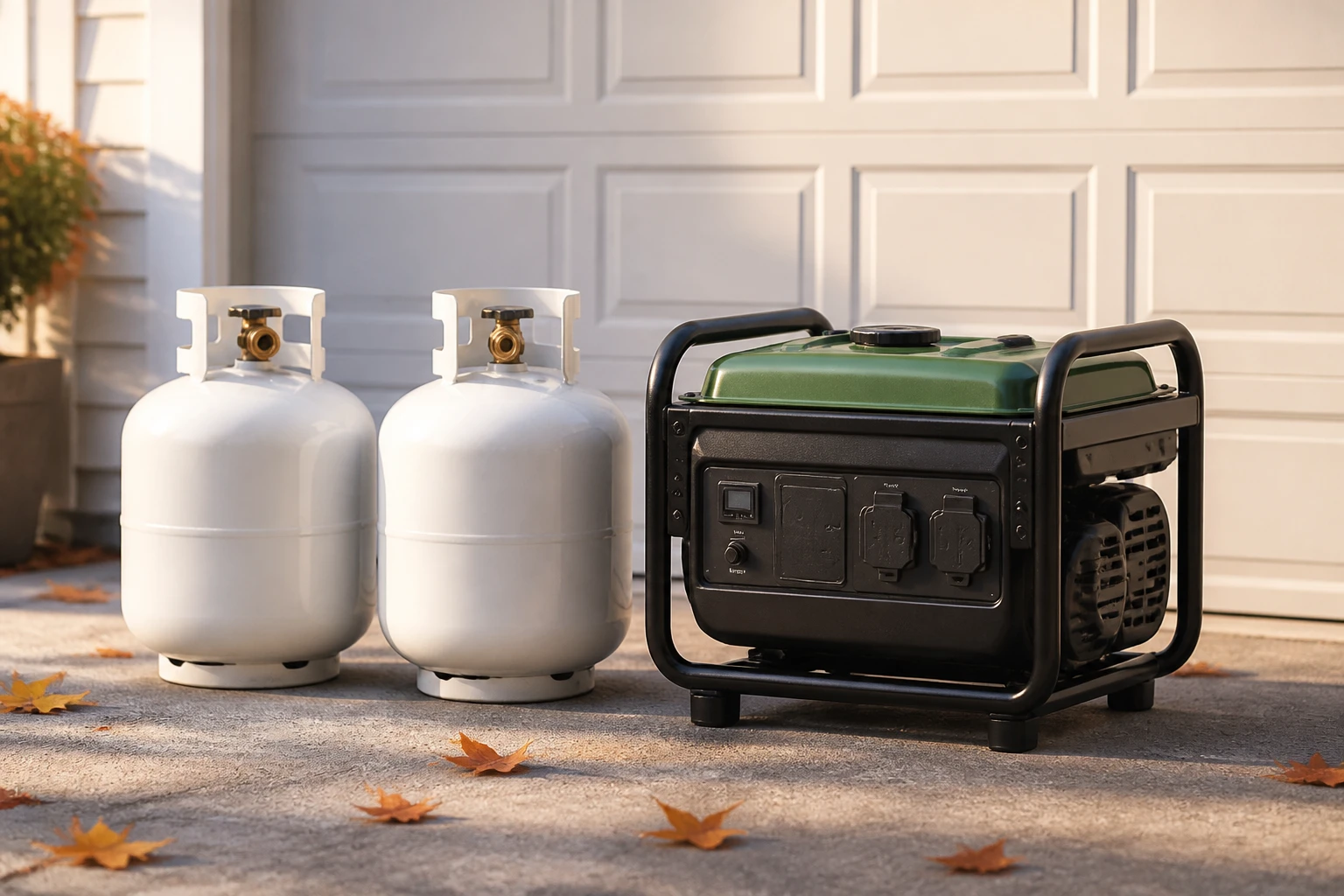
Most houses with a grill have one or two 20-lb propane tanks in the garage, and most people quietly count them as their backup power plan. So it is worth knowing what one tank really buys you: a mid-size generator at half load empties a 20-lb tank in about 5 to 6 hours.
That number surprises people who were picturing days. The rest of this page is the math behind it, so you can count your actual tanks against the outage you are planning for.
How long does a 20-lb tank last?
A 20-lb grill tank holds about 4.6 gallons of propane, and propane carries roughly 91,500 BTU per gallon (that figure comes from the U.S. Energy Information Administration). What changes between generators is how fast they drink it.
| Generator size | Typical draw at half load | Runtime on a 20-lb tank |
|---|---|---|
| Small inverter (2,500 to 4,500 W) | 0.3 to 0.5 gal/hr | 10 to 14 hours |
| Mid portable (5,000 to 7,500 W) | 0.7 to 1.0 gal/hr | 5 to 6.5 hours |
| Large portable (8,500 to 12,000 W) | 1.2 to 1.5 gal/hr | 3 to 4 hours |
A useful rule of thumb for the mid class: 2 to 3 pounds of propane per hour. Load matters more than brand. A generator loafing at a quarter load sips; the same machine near its limit roughly doubles its draw. Manufacturer runtime claims are usually quoted at 25 or 50 percent load, which is why the box sounds more generous than your driveway does.
Food and water calculator
How much food and water does your household need?
Adults
Children
For how long
You'd need
98,000calories
plus 56 gallons of water, around $185 to buy.
For 2 adults, 2 children, 2 weeks.
That's the target. Provision Planner counts what you already have and shows you what's left to buy.
See how close you areHow many tanks does a real outage take?
Nobody runs a generator around the clock. The pattern that works is cycles: power the fridge and freezer back down to temperature, charge what needs charging, run the furnace fan, then shut it off. Call it 8 to 12 running hours a day.
At that rhythm, a mid-size generator uses 1 to 2 twenty-lb tanks per day. A 3-day outage lands around 3 to 5 tanks. If you want round-the-clock power, or you are also running space heat, double it.
Two upgrades change the math. A 100-lb tank holds about 23.6 gallons, five grill tanks in one cylinder, and connects to most dual-fuel generators with the right regulator and hose. And if your house already has a big residential propane tank, a transfer switch plus the right hookup turns the fuel question into a non-issue for a week-long event.
The cold-weather catches
Winter is when outages are longest, and it is also when propane behaves worst. Three things to know before the first storm:
- A heavily drawn small tank can frost up and lose pressure. The generator stumbles even though the tank is not empty. Keeping tanks above roughly a quarter full and swapping between two tanks helps.
- Tanks live outside. Never store or run anything propane-fired indoors, and run the generator itself at least 20 feet from windows and doors, exhaust pointed away. The CDC counts carbon monoxide deaths after every major outage, and generators are the usual cause.
- Buy swaps before the storm, not during. Exchange racks empty fast once a forecast turns. This is the cheapest part of the whole plan to do early.
If you are still choosing what the generator should run first, our battery and generator runtime tool shows what a refrigerator, a space heater, or a well pump actually demands, and the power outage plan walks the first hours in order. For the stove side of an outage, there is a separate ranking of safe ways to cook without power.
Fuel is one line of the outage plan
Propane math tells you how many hours of electricity your garage is holding. It says nothing about the other lines: how many days of food and water the same house holds, what expires before you would ever eat it, and what is actually missing before winter.
Provision Planner counts what you already own, food, water, light, and heat together, and turns it into days of coverage for your household. The tank math above took you five minutes; your house's number takes about two more.
Frequently asked questions
- How long will a generator run on a 20-lb propane tank?
- A mid-size portable generator (5,000 to 7,500 watts) at half load runs about 5 to 6 hours on a standard 20-lb grill tank. A small inverter generator at low load can stretch the same tank to 10 to 14 hours. A large 10,000-watt unit may empty it in 3 to 4 hours.
- How much propane do I need for a 3-day power outage?
- Budget 3 to 5 twenty-lb tanks for a mid-size generator run in cycles (8 to 12 hours a day), and more in freezing weather. Running around the clock roughly doubles that. A 100-lb tank holds about five grill tanks' worth and removes most of the swapping.
- Is propane or gasoline better for an emergency generator?
- Gasoline carries a bit more energy per gallon, so runtimes are slightly longer. Propane wins for storage: it does not go stale, the tanks seal well, and the fuel you bought three years ago works the day you need it. Most dual-fuel owners store propane and treat gasoline as the top-up fuel.
You did the reading. Now get your number.
Provision Planner does this article's math for your real household, automatically, and keeps it current as supplies come and go.