The Flood Recovery Checklist: What to Do in the First 72 Hours
September 24, 2026 · 4min read · Reviewed against FEMA & CDC guidance
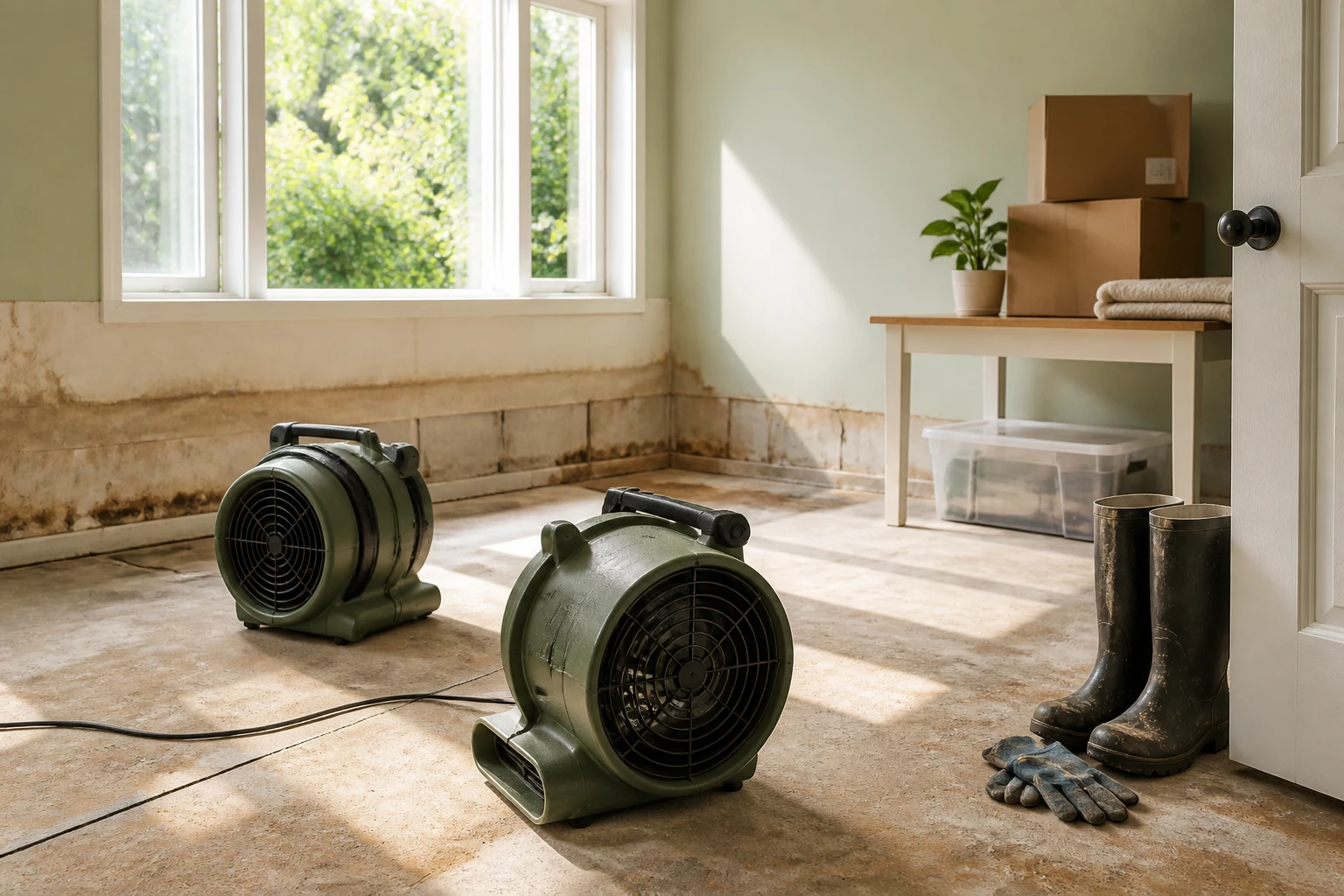
Almost every flood article is written for the week before. Far fewer are written for the morning after, which is when people are standing in a wet house with no idea what to do first.
The short answer is that the order matters more than the effort. Done in the wrong sequence, a hard day of work can cost you an insurance claim or make the house less safe than you found it. This is the sequence.
Before you go back in
The water going down doesn't make a building safe. Two things can hurt you before anything else does.
Electricity. If water reached outlets, appliances or the panel, the power needs to be off before you go in, and it should be shut off at the breaker from a dry spot. If the panel itself got wet, or you'd have to stand in water to reach it, that's an electrician's job. Don't use a generator indoors, in a garage, or anywhere near an open window.
Gas. If you smell it or hear hissing, leave, and call it in from outside. Don't flip a switch on the way out.
Then look at the building itself: sagging ceilings, buckled floors, cracks that weren't there. Wear boots and gloves. Floodwater carries sewage, fuel, and whatever was sitting in the yard uphill from you.
Document everything before you move it
This is the step people skip, and it's the one that costs the most.
Before you drag a single ruined thing to the curb, walk every room with your phone recording. Get the waterline on the walls, because that height is what an adjuster works from. Open the cabinets. Film the contents of the freezer. Capture serial numbers on appliances and electronics while they're still there.
Then photograph things individually as you remove them, and keep a running list as you go rather than reconstructing it a week later from memory. Insurers settle far faster against footage than against a written list made after the fact.
Keep receipts for everything you buy during the cleanup: fans, dehumidifiers, a hotel room, the dumpster. Much of it is claimable, and none of it is claimable without the paperwork.
The 48 hour clock
Mold can start within 24 to 48 hours. That single fact sets the priority for the first two days, and it beats every instinct to sort through belongings first.
Get the standing water out. Then get air moving: fans, open windows if the outside air is drier, a dehumidifier if you can get one.
Pull up carpet and padding. The padding is always a loss. Carpet sometimes isn't, but it can't dry in place on a wet subfloor. Cut away soaked drywall to above the waterline, usually a foot higher than the stain, because the paper backing wicks moisture upward and insulation behind it holds water for weeks.
Open up the closed spaces. Cabinet doors, drawers, wall cavities. Anything sealed stays wet.
What has to go
Contamination is the deciding factor here, and how bad a thing looks tells you very little about it. Porous materials that soaked up floodwater don't come back:
- Carpet and padding, mattresses, upholstered furniture
- Particle board and anything laminated
- Insulation
- Cosmetics, medicines and baby bottles
- Any food that touched floodwater unless it's in a sealed, waterproof container
Undamaged cans and retort pouches survive, but they need washing and sanitizing before you open them. Screw-top jars and anything cardboard do not survive, however sealed they look.
If the power also failed, the power outage food safety rules stack on top of this: four hours for the fridge, 24 to 48 for a freezer left closed.
When in doubt, throw it out. Food is replaceable.
The scams arrive with the trucks
Contractors show up in flooded neighborhoods within days, and most of them are fine. The ones that aren't share a pattern: they knock on your door, they want a large deposit in cash, they pressure you to sign today, and they can't give you a license number.
Get it in writing. Check the license. Don't pay in full up front. Your insurer can usually tell you who they've worked with locally, and that call takes five minutes.
Then the part nobody plans for
Recovery is slow, and the most useful thing you can do in the first week is keep records: what was lost, what was spent, who you spoke to and when. It's tedious at exactly the moment you have the least patience for it, and it's what determines how much of this you get back.
Rebuilding the supplies you just used
Whatever you had stored, the flood either ruined it or you used it. That's the moment most households quietly go back to unprepared, because nobody wants to think about the next one while they're still drying out from this one.
Provision Planner is a way to rebuild deliberately rather than by memory. Add what actually survived, and it tells you how many days your household is covered rather than how many items you own. Run the flood scenario and it shows what you'd still run short of, which is a far easier conversation to have now, with the experience fresh, than in five years when it's abstract again.
Frequently asked questions
- How long before mold grows after a flood?
- Mold can start within 24 to 48 hours on wet materials. That clock is why drying takes priority over cleaning and over sorting through belongings. Get the standing water out, get the air moving, and pull up soaked carpet and padding first.
- What should you throw away after a flood?
- Anything porous that absorbed floodwater: carpet and padding, mattresses, upholstered furniture, particle board, insulation, and any food not in a sealed waterproof container. Floodwater carries sewage and chemicals, so how bad a thing looks tells you very little about whether it can stay.
- Should I photograph flood damage before cleaning up?
- Yes, and before you move anything. Insurers settle far faster against footage than against a written list made afterwards. Walk every room with your phone recording, get the waterline on the walls, open the cabinets, and capture serial numbers on appliances before they go to the curb.
Food and water calculator
How much food and water does your household need?
Adults
Children
For how long
You'd need
98,000calories
plus 56 gallons of water, around $185 to buy.
For 2 adults, 2 children, 2 weeks.
That's the target. Provision Planner counts what you already have and shows you what's left to buy.
See how close you areYou did the reading. Now get your number.
Provision Planner does this article's math for your real household, automatically, and keeps it current as supplies come and go.