Earthquake Kit Checklist: Home, Car, and Work
July 12, 2026 · 4min read · Reviewed against FEMA & CDC guidance
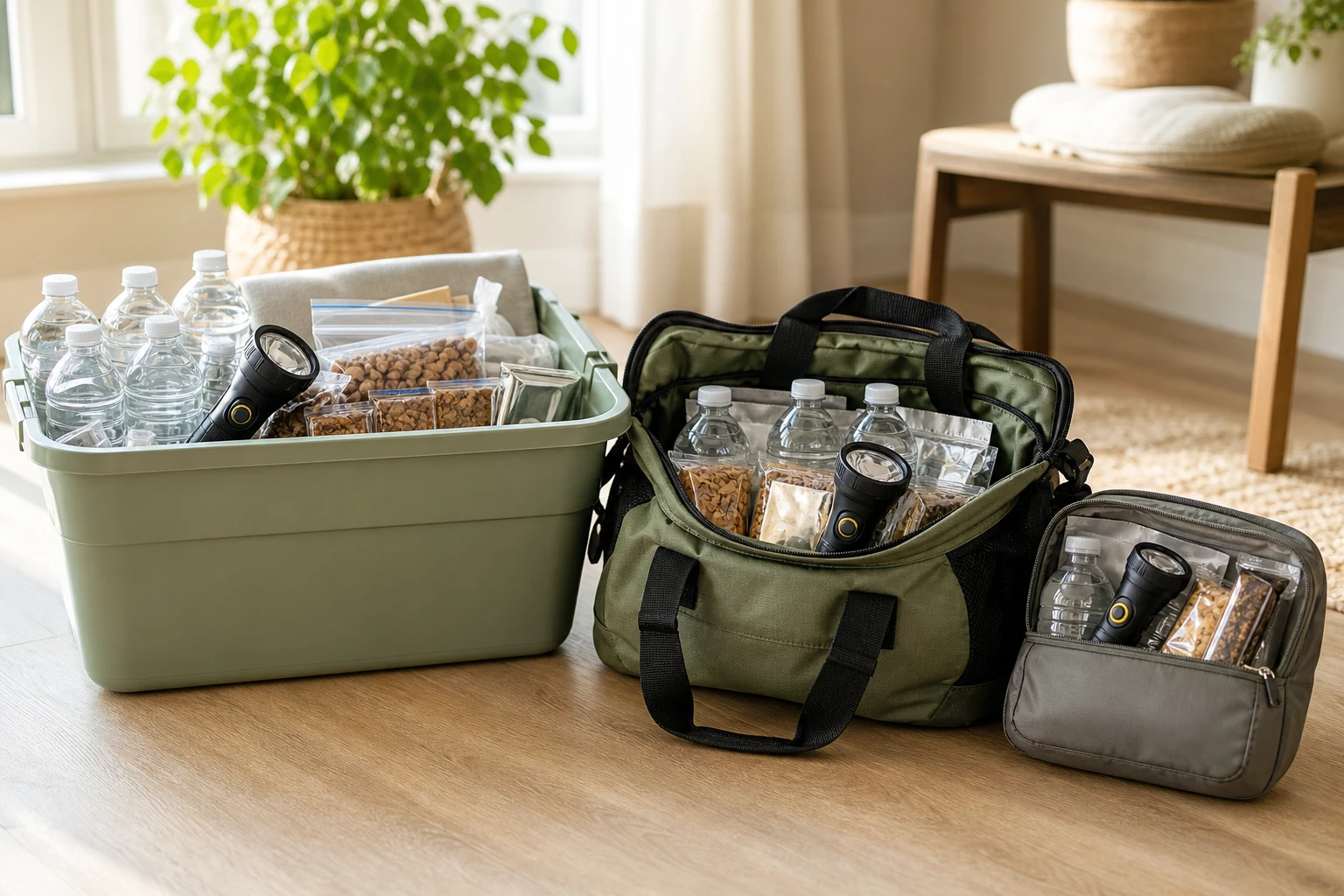
Most disasters send a warning. A hurricane gives you days, a winter storm a forecast, a wildfire a watch. An earthquake gives you nothing, and that single fact rewrites how you build the kit.
Because a quake can hit while you are asleep, on the freeway, or at your desk, the goal is not one perfect bag but three small kits in the three places you actually spend your hours: home, car, and work. Home carries the weight, aiming for two weeks of water and food, while the car and desk kits cover at least three days until you can get back. The U.S. Geological Survey keeps the advice during the shaking itself simple: drop, cover, and hold on. Everything below is for the hours and days after.
Why one earthquake kit is really three
Preparedness guides usually picture a single go-bag by the door. That works for a flood you see coming. It fails the moment a quake strikes during your commute and your one good kit is fifteen miles away in a closet. Spreading supplies across the places you live your life means the odds are high you are standing next to a kit when it counts. Same checklist, three sizes.
Food and water calculator
How much food and water does your household need?
Adults
Children
For how long
You'd need
98,000calories
plus 56 gallons of water, around $185 to buy.
For 2 adults, 2 children, 2 weeks.
That's the target. Provision Planner counts what you already have and shows you what's left to buy.
See how close you areThe home kit (where most of the supply lives)
This is the anchor. Build it toward two weeks for everyone under the roof.
- Water: 1 gallon per person per day, so 14 gallons per person (the water storage math scales it by household)
- No-cook food, about 2,000 calories per adult per day, plus a manual can opener
- A pair of sturdy shoes and a flashlight under every bed, because the first walk after a quake is across broken glass in the dark
- Work gloves, a dust mask, and a wrench or shutoff tool for the gas meter
- First-aid kit, prescriptions, a battery or crank radio, and a whistle
- The rest of the go-bag basics are already itemized in the 72-hour kit checklist
One bonus source hides in plain sight: a strapped water heater holds 40 to 50 gallons of drinkable water. Securing it is both a safety fix and a reserve tank.
The car kit (you may be driving when it hits)
Your vehicle is where a lot of people are when the ground moves, and it may become your shelter if roads close. Keep a case of water bottles, a few days of food bars, a spare pair of walking shoes, a blanket, a flashlight, and a charger. Most of this overlaps the everyday car emergency kit, so build one bin that answers both jobs rather than two.
The work kit (a third of your life is here)
The forgotten one. You spend roughly a third of your week at a desk or job site, so a compact pouch in a drawer or locker matters more than it sounds:
- Two or three water bottles and a few calorie-dense food bars
- Comfortable shoes you can walk home in, the single most-appreciated item after a real quake
- A small first-aid kit, a 3-day medication buffer, a dust mask, and a whistle
- A flashlight and a backup charger
The earthquake-only details people miss
- Secure the heavy things now: anchor bookcases, strap the water heater, and add latches to cabinets. Most quake injuries come from falling objects, not collapse.
- Learn your gas shutoff and keep the wrench beside the meter, so you can act fast if you smell gas.
- Plan for broken mains: tap water can go unsafe for days, so keep a way to treat it (the water purification options cover boiling, bleach, and filters).
- Pick an out-of-area contact everyone texts, since local lines jam but a distant relay often gets through. It belongs in your family emergency plan, and the plan template gives it a line.
| Kit | Water | Food | Signature items |
|---|---|---|---|
| Home | 2 weeks (14 gal/person) | 2 weeks no-cook | Shoes and light under every bed, gas wrench, radio |
| Car | 3+ days (a case) | Bars, jerky, nuts | Walking shoes, blanket, jumper pack |
| Work | 3 days (2 to 3 bottles) | Food bars | Comfortable shoes, meds buffer, dust mask |
Three kits means three sets of expiry dates
The quiet failure of a three-kit system is drift. The desk water is two summers old, the car bars melted and re-hardened, the home meds expired, and you find out the day you reach for them. Spreading supplies out solves the location problem and creates a memory problem.
Provision Planner closes it by treating each kit as its own location. Log Home, Car, and Work once, and the app tells you what is expiring in each, what is missing against your household size, and how many days all three add up to, so a set-and-forget kit stays a real one.
Frequently asked questions
- What should be in an earthquake kit?
- Water (1 gallon per person per day), no-cook food, sturdy shoes and work gloves, a flashlight, a first-aid kit, medications, a whistle, a dust mask, a battery or crank radio, and a wrench to shut off gas. Build the largest version at home and smaller versions for your car and workplace.
- Do I need more than one earthquake kit?
- Yes. Because a quake strikes with no warning, you could be asleep, driving, or at work when it hits. The practical answer is three kits in the three places you spend your time, so you are never far from supplies no matter where the shaking starts.
- How much water goes in an earthquake kit?
- One gallon per person per day. Aim for two weeks at home, and keep at least three days' worth in the car and workplace kits. Because water is heavy, most of it stays home while the car and desk hold a smaller bottle supply.
You did the reading. Now get your number.
Provision Planner does this article's math for your real household, automatically, and keeps it current as supplies come and go.