Best Emergency Food Kits of 2026: What 5 Popular Kits Actually Feed You
July 13, 2026 · 5min read · Reviewed against FEMA & CDC guidance
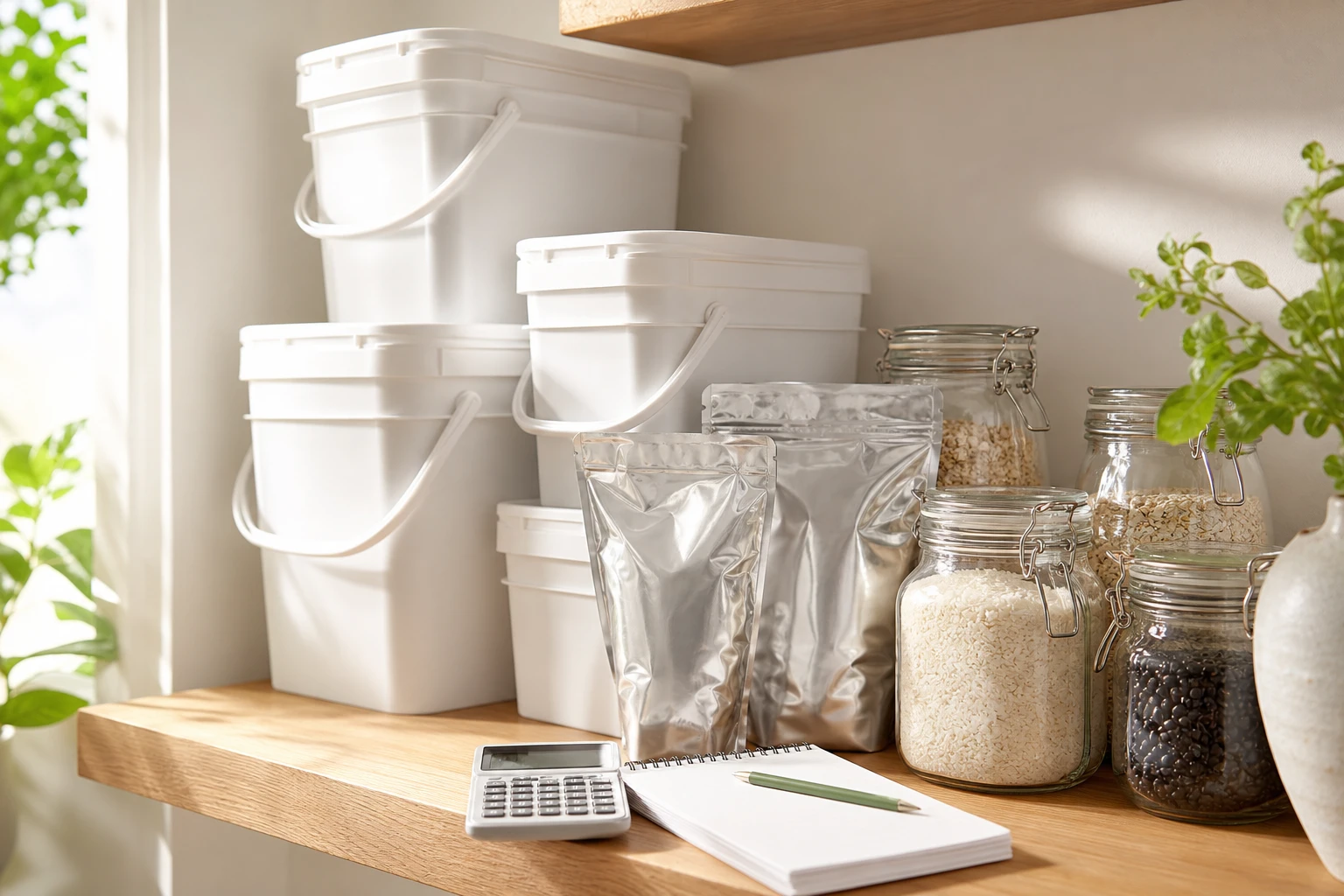
A stackable bucket stamped "30-Day Emergency Food Supply" is a genuinely tempting shortcut: one purchase, a tidy handle, a shelf life measured in decades. The question worth asking before you click buy is the one printed in the smallest font on the label.
That question is calories. Many kits count a "day" as 1,200 to 1,500 calories, well under the roughly 2,000 a moderately active adult needs by USDA figures, so a "30-day" bucket is often closer to 20 real days of eating. Once you correct for that, the honest comparison stops being kit versus kit. It becomes convenience versus cost per calorie, and here is that math laid out plainly.
Read the calories before the day count
Do one piece of arithmetic on any kit before you compare prices: find the total calories on the label and divide by 2,000. A bucket advertised as a month that lists 30,000 total calories is really 15 days for one adult, and the sticker price should be judged against that, not the marketing number. This single division reshuffles almost every "best kit" ranking online, because the cheapest-looking buckets are usually the ones counting the smallest days.
Food and water calculator
How much food and water does your household need?
Adults
Children
For how long
You'd need
98,000calories
plus 56 gallons of water, around $185 to buy.
For 2 adults, 2 children, 2 weeks.
That's the target. Provision Planner counts what you already have and shows you what's left to buy.
See how close you areFive popular kits, corrected
That division, done for the five kits that come up most often, using each maker's own published calorie figures as of September 2026. "Real days" is total calories divided by 2,000, roughly what one moderately active adult needs.
| Kit | Sold as | Published calories | Real days | Short by |
|---|---|---|---|---|
| ReadyWise 4-Week | 28 days | over 2,000 a day | 28 | nothing |
| Mountain House 30-Day | 30 days | 1,732 a day | 26 | 13% |
| 4Patriots 3-Month | 90 days | 1,555 a day | 70 | 22% |
| 4Patriots 4-Week | 28 days | 36,480 total | 18 | 35% |
| 4Patriots 2-Week | 14 days | 1,320 a day | 9 | 34% |
Two things stand out.
ReadyWise publishes over 2,000 calories a day, so their four-week kit really is about four weeks. That is rarer than it should be and worth knowing.
The 4Patriots two-week kit feeds one adult for about nine days. Not because anything is hidden: the 1,320-a-day figure is printed on their own page. It only becomes a surprise if you read the number on the front of the box and not the one on the back.
Nobody here is lying. They are all counting a "day" the way the industry has decided to count one, which is a day you would notice being hungry through. Do the division yourself and the comparison changes shape entirely.
Check the current figures before you buy. Recipes and pack sizes change, and so do prices, which is why the table above compares calories rather than dollars. Once you know the real day count, divide the current price by it and you have the only number that lets you compare a bucket against a bag of rice.
The real cost per day
Corrected to full 2,000-calorie days, the categories separate cleanly. These are directional ranges to compare types, not brand quotes, so check the label in front of you:
| Option | Cost per 2,000-cal day | Shelf life | Best for |
|---|---|---|---|
| DIY staples (rice, beans, oats) | ~$0.60 | 25 to 30 years | The cheapest calories, if you do the work |
| Dehydrated staple buckets (just-add-water rice, beans, potatoes) | ~$4 to $7 | 25 to 30 years | Real calories with far less effort |
| Freeze-dried meal buckets (branded entrees) | ~$8 to $15 | 25 to 30 years | Taste, variety, and zero cooking |
| Emergency ration bars | ~$3 to $5 | ~5 years | Compact, grab-and-go, no water needed |
The pattern is the one the 25-year food guide found from the storage side: buckets often cost five to ten times more per calorie than the same rice and beans bought in bulk. That markup is not a scam, it is what you pay for packaging, portioning, and not having to think. Whether it is worth it depends entirely on which of those you actually need.
Where a kit is genuinely worth it
- You have no time or space to build storage. A bucket in a closet beats a perfect plan you never execute.
- You want variety to fight appetite fatigue. Eating plain rice for two weeks is grim, and kits bring flavor and structure that keep people actually eating.
- The kit is your grab-and-go layer. Sealed, portioned, and light, a small kit rides in an evacuation vehicle better than loose staples.
- Someone has dietary needs a kit already meets, like gluten-free or vegetarian lines that save you the sourcing.
Where do-it-yourself wins
Cost and quantity, decisively. If your goal is the most days of calories per dollar, bulk staples are unbeaten, and they let you store food your family already eats and rotates. The shoppable starting points are the best foods to stockpile and the 2-week food supply list, both built from grocery-store items rather than specialty pouches. Most well-prepared households land in the middle: a base of cheap staples for depth, plus one small kit for variety and grab-and-go.
How to buy a kit without regret
- Divide total calories by 2,000 for the true day count, then compare on that number.
- Check the sodium and sugar, since some kits hit their calories with drink mixes and dessert pouches.
- Confirm the prep water, because "just add water" can quietly demand gallons you also have to store.
- Taste one pouch before you commit a month of dinners to a flavor nobody likes.
- Buy the kit as a supplement to staples, not as the whole plan.
A kit still cannot tell you your number
Whether you buy buckets, build DIY, or blend the two, the same blind spot remains: a label counts its own calories, not your household's real coverage. It cannot see the canned goods already in your pantry, the water you have stored, or how the math changes with a toddler and a dog in the house. So people over-buy in one category and stay short in another.
Provision Planner closes that gap by counting everything together. Scan a kit, your staples, and your pantry into one place, set your actual household, and it returns the only figure that matters: how many days your family could truly last, and exactly what to buy next to extend it.
Frequently asked questions
- Are emergency food buckets worth it?
- Sometimes. Buckets buy convenience, variety, and a decades-long shelf life, but they cost several times more per calorie than do-it-yourself staples, and many advertise a day count using low 1,200-calorie servings. Read the calories per day, not the number of days on the label.
- How many calories are in emergency food kits?
- Many '30-day' buckets provide only 1,200 to 1,500 calories a day, below the roughly 2,000 an adult needs. Divide the total calories on the label by 2,000 to get the real number of full days the kit actually feeds one adult.
- What is the cheapest emergency food?
- Do-it-yourself staples like rice, beans, and oats run well under a dollar per 2,000-calorie day and last 25-plus years when sealed properly. Kits trade that low cost for convenience, taste, and zero prep effort.
You did the reading. Now get your number.
Provision Planner does this article's math for your real household, automatically, and keeps it current as supplies come and go.