The 3-Month Food Supply List: What It Actually Takes
May 29, 2026 · 3min read · Reviewed against FEMA & CDC guidance
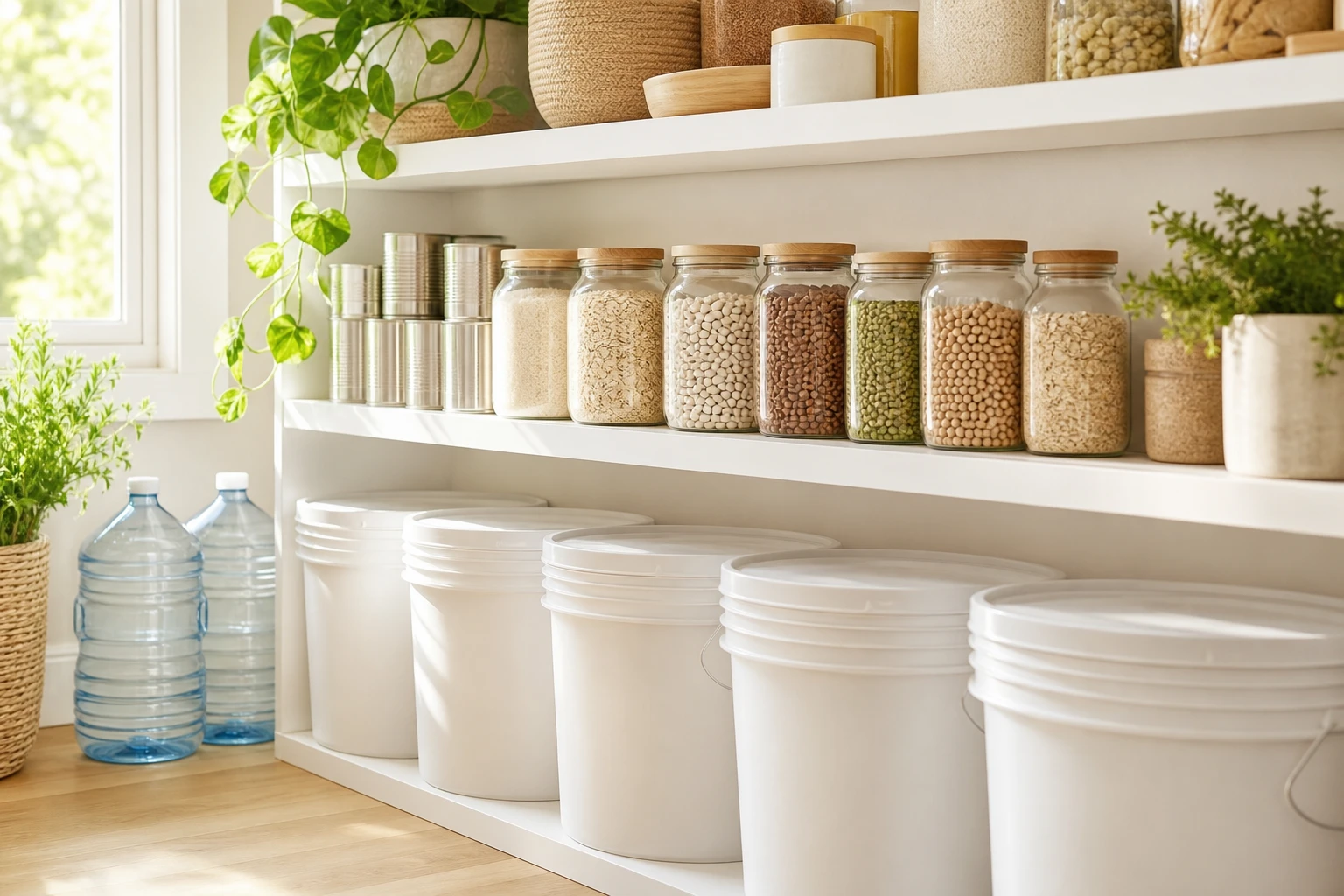
A 3-month food supply is where preparedness graduates from "riding out a storm" to real household resilience: job loss, supply disruptions, a bad winter, a regional disaster with a slow recovery. The math is bigger but the method is identical to the two-week version, and the food is still mostly from a normal grocery store.
The target: 2,000 calories per person per day, times 90 days = 180,000 calories per person. A family of four needs roughly 720,000 calories. Deep breath: that's about $600 to $900 per person done cheaply, built over months, and it fits in a closet.
The structure: two layers, not one giant pile
Layer 1: one month of everyday shelf food (rotated). Triple your normal 2-week supply list: rice, pasta, oats, canned proteins and vegetables, oil, peanut butter, comfort food. You eat and replace this constantly, so nothing expires.
Layer 2: two months of deep storage (sealed). Bulk staples in mylar-lined buckets that you seal once and forget: white rice, dried beans, oats, pasta, sugar, salt. This layer is cheap, dense, and lasts decades. If you're sizing it past three months, the LDS year supply calculator gives the classic per-person staple amounts at any household size.
Splitting it this way solves the two classic 3-month failures: all-shelf food expires faster than a family can rotate it, and all-buckets means eating plain rice by week two.
The per-person list
Layer 1 (30 days, rotated):
- 10 lbs rice, 6 lbs pasta, 5 lbs oats
- 12 cans beans, 9 cans meat or fish, 3 jars peanut butter
- 20 cans vegetables, 12 cans fruit, 8 cans soup or chili
- 2 large bottles cooking oil, honey, salt, spices, coffee or tea
Layer 2 (60 days, sealed):
- 50 lbs white rice (about 80,000 calories)
- 25 lbs dried beans and lentils
- 20 lbs oats
- 10 lbs pasta
- 10 lbs sugar, 4 lbs salt
- Bouillon, powdered milk, and a multivitamin (real gap-fillers on a staples diet)
Water: 90 days of drinking water is 90 gallons per person, which is a storage strategy of its own. Store two weeks minimum plus a purification plan for the rest.
The three details that make it work
- Buy Layer 2 in one weekend, build Layer 1 gradually. Bulk staples are cheap enough to just do; the rotated layer grows $20 a week (the budget plan scales directly).
- Fat is the bottleneck. Oil is the shortest-lived essential and the densest calories. Never deep-store it; always rotate it.
- Calories, not containers. Count what you actually have, not how full the shelf looks. The family-of-4 math shows the method.
Ninety days is an inventory problem, not a shopping problem
Buying this list once is a project. Knowing what's left of it eighteen months later, what expired, and how many days it currently buys your household is the part that quietly fails. Provision Planner is built for exactly that: scan it in as you build, and your dashboard holds the one number that matters, updated as the family eats: how many days you're actually covered for, right now.
Frequently asked questions
- How much food do you need for a 3-month supply per person?
- About 180,000 calories per person for 90 days at 2,000 a day. In practical terms that's roughly 45 lbs of grains, 15 lbs of beans or other protein, plus canned goods, fats, and comfort foods layered on a base of shelf-stable staples.
- How much does a 3-month food supply cost?
- Built from bulk grocery staples, a 90-day supply runs roughly $250 to $400 per person if you buy rice, beans, oats, and canned goods over several trips. Pre-packaged bucket kits cost two to four times more for the same calories.
- Where do you store a 3-month food supply?
- It fits in a closet or under beds more easily than people expect. Ninety days of staples for one person is about six to eight stackable bins. Keep it cool, dark, and dry, and treat it as two layers: a deep pantry of foods you eat plus a long-term staple base.
Food and water calculator
How much food and water does your household need?
Adults
Children
For how long
You'd need
98,000calories
plus 56 gallons of water, around $185 to buy.
For 2 adults, 2 children, 2 weeks.
That's the target. Provision Planner counts what you already have and shows you what's left to buy.
See how close you areYou did the reading. Now get your number.
Provision Planner does this article's math for your real household, automatically, and keeps it current as supplies come and go.